What does the Bible say about a Christian wife and unbelieving husband? Scripture offers practical wisdom for honoring Christ and strengthening her witness.
Roger Smalling, D.Min
Understanding the context of 1 Peter
I am strolling through a minefield, trying to watch where I step. Whenever we address issues regarding husbands and wives, women’s rights, and gender questions, people filter what is said through the lens of their own experiences or cultural norms. People question those norms, and socio-political issues enter the picture, along with many emotions.
Peter has some striking things to say about those issues. If you are single or have a good marriage, you may assume these do not apply to you. Who knows when you may find yourself having to counsel someone living with an unsaved mate? You’ll have a clearer understanding of what God says in his word and can provide godly counsel from it.
If Peter were to touch on every possible situation, his book would be the size of an encyclopedia. So we are going to address the general principles in this text.
We need to see these verses in the context of the book as a whole. In the opening verses of 1 Peter, he reveals he is addressing Jewish Christians living outside of Palestine in regions dominated by the pagan Roman Empire. A major theme is how Christians are to relate to authority in a non-Christian culture.
The meaning of “Likewise”
Chapter 3 is a continuation of that theme. Peter is not changing the subject when he talks about the relationship between wives and husbands here. We see this by the first word of the text, “Likewise…” Other translations, such as the NIV, render it as, In the same way…
In the same way as what? Let’s go back to Chapter 2 and notice what Peter is talking about.
Submission and authority
Be subject for the Lord’s sake to every human institution, whether it be to the emperor as supreme, 14 or to governors as sent by him to punish those who do evil and to praise those who do good. 15 For this is the will of God, that by doing good you should put to silence the ignorance of foolish people. 1 Peter 2:13-
Then he repeats in verse 17, “Honor the emperor.”
Though the emperor is not a believer or even necessarily a moral man, this fact does not negate the authority inherent in the office. His official functions may have nothing to do with his character. He does not mean to honor everything they do if it is sinful. Peter is telling us to honor the office insofar as the man is fulfilling his normal functions and authority to maintain civil order.
Why a Christian wife submits to an unbelieving husband
Why do we submit? Peter offers three reasons:
• That God may be glorified. By doing that, we are saying we believe in absolute universal moral law.
• That the gospel may be understood and get a hearing so some might be won to Christ.
• That Christians may avoid legitimate criticisms. Although criticisms will occur, they will eventually be proven false and the accusers put to shame.
That’s why Chapter 3 begins with the word “likewise.” Let’s remember that in the days of the Roman Empire, they had ungodly, self-serving politicians like today.
When Peter says, “Likewise wives, submit to your own husbands,” he is declaring something in the office of husband to which the wife submits, even though he is not saved.
A parallel text in Ephesians Chapter 5 says the wife should submit to her husband in everything just as the church submits to Christ. Sometimes teachers blend together
1 Peter 3 and Ephesians 5 insist that the wife should submit to her husband in everything, perhaps even abuse, whether he is Christian or not.
This argument is mixing apples and oranges, and I disagree with blending these chapters in that way. Paul was talking about a Christian couple in their relationship to one another as they relate to Christ. Peter is talking about marriages in which one spouse is a believer whereas the other is not. Peter’s approach was from this angle, and that changes the scenario a lot.
In such mixed marriages, it is usually the wife who is saved and the husband who is lost. This difference is apparent for two reasons: The way Peter uses the word “likewise” plus the phrase even if some [husbands] do not obey the word. Obviously the term refers to an unsaved person. So Peter is approaching the subject of marriage from a different angle than does Paul in Ephesians.
The difference between gender and office
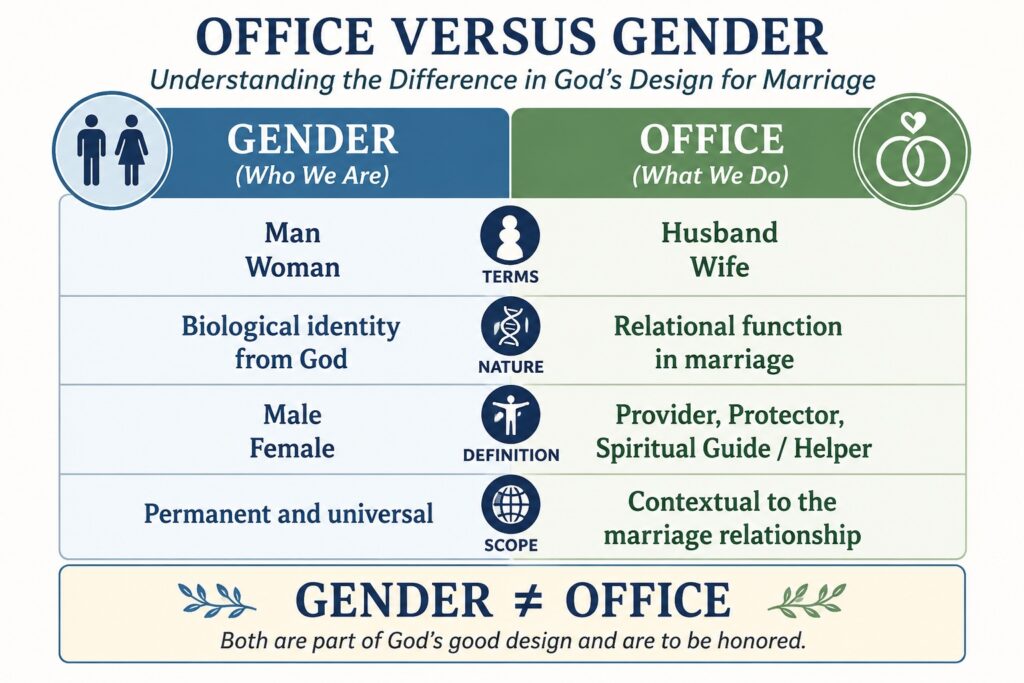
To understand why the wife is to submit to her husband, even though he is not saved, we need to go back to Genesis. Peter was a Jew, writing to Jewish Christian exiles, and he knew they understood the principles in the Genesis text. We Gentiles, however, may need to review these to discern Peter’s assumptions that would lead him to instruct Christian wives the way he did.
When God created Adam, he gave him a job: caretaker of the creation and co-regent with God in the ruling of it. This role implies a leadership function by the nature of the case. He created woman to help the man in that role. Adam was male and worked as a gardener. In his relationship to Eve, he held the office of husband. Eve had a gender, female, and a job description, helper or assistant gardener, if you please.
This point may appear to be splitting hairs. Yet the split is essential to understand where Peter is coming from. Gender is one thing, office another, although they are blended. The terms “man” and “woman” are descriptions of gender. The words “husband” and “wife” refer to offices and functions in relation to one another.
When Adam became a husband, he was still the caretaker of the garden. By the nature of that function, he was in charge, and his wife was his assistant. This position granted a leadership responsibility relative to his wife.
Any office, by definition, contains elements with the authority to fulfill its functions. As we look throughout Scripture at the office of husband, we see three functions relative to his wife: provider, protector, and priest. By “priest” I mean “spiritual guide.” I use “priest” because it starts with the letter P and helps to remember these points. He is the spiritual leader, mentor, and moral example to his family.
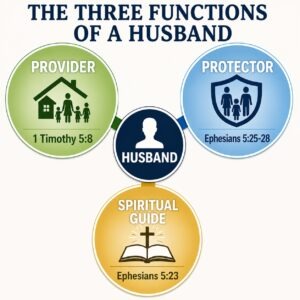 Ephesians 5 reflects this kind of relationship, with Christ providing these benefits to his church as the example. He is our provider, protector, and priest—our sanctifier.
Understanding the difference between gender and office, man and woman versus husband and wife, is essential to Peter’s point.
The point: In no place does the New Testament indicate a married woman must submit to a man. The apostles affirm that a wife submits to her husband.
What changed after the fall?
A lot changed when Adam and Eve fell, in case we haven’t noticed! But some things did not. Adam’s job as caretaker of the earth did not change. As a form of judgment, God made his job harder. More weeds and sweat. Gardening was not fun anymore. Nor did Eve’s job description change. It became more painful.
Adam’s responsibility toward his wife did not change either. He remained a provider and protector. Though a sinful man, he was still a husband. Nor did Eve’s job description change. She was still her husband’s helper. Therefore, she was still in submission to Adam as her husband, receiving the benefits of protection and provision. This means submission to his office as a husband, not just because he is a man.
As protector, issues of spiritual warfare are the husband’s responsibility. It is the man’s job to deal with snakes in the garden. Both got into trouble when they stepped outside of God’s assigned functions. The Genesis text says Eve gave Adam the forbidden fruit because it states he was with her. Why was he with her instead of she with him? He is supposed to be the provider, the caretaker of the garden. That’s why in Genesis Chapter 3, God rebukes them both for going outside of their assigned roles and disobeying him.
That’s why God’s reproach to Adam was because you listened to the voice of your wife… There are times a husband should listen to his wife, but that was not one of them.
Adam stepped outside of his role to the detriment of them both.
When we start to fool around with God’s order of creation regarding the roles of husband and wife, we are headed for trouble. Whether one’s spouse is saved or not, the believer must keep the created offices and functions in mind as much as possible. Otherwise, things are likely to get worse rather than better.
That’s what Peter is talking about in the concept of authority throughout this book. Even though the husband is not saved, he still holds the office of husband. Even though a politician may not be Christian, we as citizens must respect him as he fulfills the legitimate functions of his office.
What Peter means by “be subject”
Verse 1- be subject
In what way? Likewise, in the same way a citizen is subject to a governor. We do not fall at the feet of the governor nor act in a senseless, servile manner. We show respect to the office where respect is due. Peter is teaching submission to authority in a society where non-Christians may be in authority over us.
What about abuse?
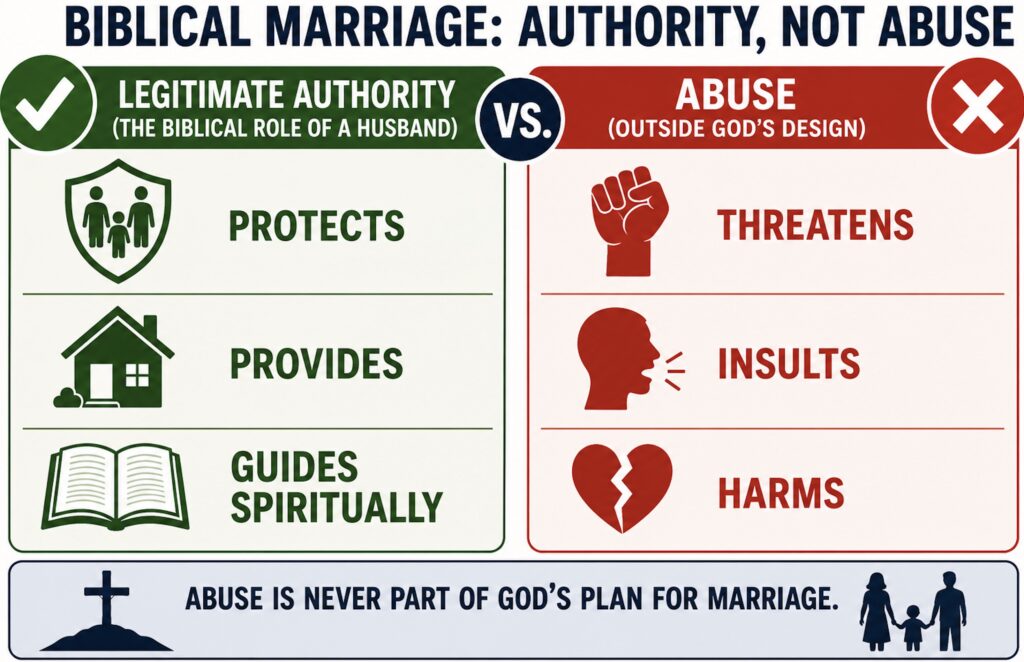
Now, this is where we begin to navigate potential pitfalls. Suppose a man is abusing his wife. Does this mean she must submit? No! The apostles never insinuate a wife must submit to abuse. If a husband is abusive, he has stepped outside of his legitimate office and functions as a husband. It is no longer a husband abusing a wife; it is a man abusing a woman. He is no longer a protector. The fact that he is a man is irrelevant. “Abuser” is not one of his job descriptions.
By abuse, I mean either verbal or physical. What if an unsaved mate demeans you with profane words? Peter already gave us a clue in Chapter 2 relative to government authorities. The mate does not need to accept it meekly. There are things to do and things to avoid. Refrain from giving back reviling for reviling or insult for insult, and do not threaten. No evil for evil.
You may say, “That language is abusive, and I do not accept it. I do not respond to that.”
Above all, avoid insulting his manhood. That could be dangerous.
Why Peter says “your own husbands”
Verse 1—to your own husbands
Why own husbands? A Christian woman is not subject to every man, just one. If that were not what Peter was thinking, there would be no reason to add that word, “own.”
Here is where overlapping with Ephesians 5 is legitimate. The church should submit to Christ in everything. The church is run by elders. Does that mean every Christian woman must submit to these elders in everything relative to the church? Maybe and maybe not. The Ephesians text says the husband is the head of the wife. The church is not the head of the wife. If the elders ask a woman to do a particular job in the church and the husband does not want her to do that, how is the conflict resolved? Answer: The husband decides.
How an unbelieving husband may be won
Winning without a word
Verse 1- “…they may be won without a word by the conduct of their wives.”
Peter is addressing do’s and don’ts for believers in a mixed marriage. The Christian wife of an unsaved man should avoid preaching to him. A man’s ego is likely to rise up and decide that becoming a Christian implies submitting to a woman. Such behavior is counterproductive! Wait until he asks questions, then give a biblical answer and leave it at that.
Respectful conduct
Verse 2—”when they see your respectful and pure conduct”
Respectful to whom? First to God and then her mate. Some older translations use the word “fear.” Subsequent language studies show this is an expression in Greek intended to mean reverence or respect. The reverence is to God as she looks to him to help her in her God-given functions.
The devil may insinuate, “He is unsaved, and it is your fault. If you were a better Christian wife, he would come to Christ.” What a lie! As though God were limited to her! Jesus said, “No one can come to me unless my father draws him.” (1) God may use her as his agent, but he may not. If he is not saved, it is his fault. She should live in a manner that glorifies God regardless of whether he comes to Christ.
Godly spirit
This is what our lives are about: the glory of God.
Verse 3- “Do not let your adorning be external—the braiding of hair and the putting on of gold jewelry, or the clothing you wear—4 but let your adorning be the hidden person of the heart with the imperishable beauty of a gentle and quiet spirit, which in God’s sight is very precious.”
In winning the husband, a believer should dress nicely for her mate while showing where her real values are. Peter warns of the prevalence of vanity in any culture. Unsaved people are attracted to the visual and susceptible to this sin.
In Latin America, we occasionally encountered legalistic believers who take literally the phrase “braiding of hair and putting on of gold jewelry” to forbid church members from wearing even wedding rings. Peter uses an untranslatable Greek word referring to a flamboyant style of Roman hairdo. The hair was piled up and bound with filaments of gold strung with pearls. The intent was to display how rich and powerful their husbands were. That’s not likely to happen in Christian circles today.
Sarah as an example of faith
Verse 5—”For this is how the holy women who hoped in God used to adorn themselves, by submitting to their own husbands, 6 as Sarah obeyed Abraham, calling him ‘lord.’ And you are her children, if you do good and do not fear anything that is frightening.”
A wife’s adornment is to fulfill her created function in relationship to her husband.
According to commentators, the term “lord” refers to a cultural norm and simply meant “my husband,” meaning she recognized him as her head. The norms for expressing respect and affection to a husband differ widely between cultures, and Peter is encouraging believing wives to express themselves within those norms.
Verse 6—”And you are her children, if you do good and do not fear anything that is frightening.”
This phrase, “do not fear anything that is frightening,” is next to impossible to translate because the word “frightening” is ambiguous in the original Greek. The word only occurs this once in the New Testament and is rare even in classical Greek. It apparently means “do not be easily alarmed.” Her reactions to circumstances in life should be a testimony to her belief in God’s control.
The role of the husband
The role of the husband
Verse 7- “Likewise, husbands, live with your wives in an understanding way, showing honor to the woman as the weaker vessel, since they are heirs with you of the grace of life, so that your prayers may not be hindered.”
Remember, the functions of a husband are to be the provider, protector, and spiritual guide of the family. It’s up to him to know the spiritual concerns of his wife. He must take the lead in the spiritual development of the home and not leave it to the church alone. Is he concerned for her growth in grace, , inquiring about her quiet time and praying with her for needs?
If not, he is only two-thirds of a husband. Though he may be a provider and protector but not her spiritual guide, then he is failing in one-third of his function as a husband, and that particular third is ultimately the most important.
This may sound unbelievable, but we have actually encountered Christian couples who never pray together. Can we imagine Peter never praying with his wife? If Peter were here, he might ask, “How can you be heirs together of the grace of life if you are not doing that?” He might look at the man and say in his characteristic gentle way, “What’s the matter with you, mister?!”
Peter might say to the couple, “Look, you are two Christians married to one another, and that makes you a couple. But does that alone make you a Christian couple?”
Think about that. Are they just two Christians who happen to be married to one another? In what way is the husband fulfilling his role as priest of the home?
Verse 7—Likewise, husbands, live with your wives in an understanding way, showing honor to the woman as the weaker vessel.
Some feminists assume this text implies a woman is inferior. Dead wrong, and two reasons why:
First, that word “likewise” again. Remember, this term has to do with submission to authority. Is it proper here? Yes! A wife has a created office with functions. A husband submits to her office insofar as he is able to help her in these.
Honoring the wife as the weaker vessel
Second, the word “honor” here means “recognition of importance and value.” (2) It is the same word Peter uses for honoring the emperor in Chapter 2. It is a word used for showing honor to church elders.
It does not mean a condescending attitude, as in “you poor little thing.” Other terms exist that Peter could have used. The importance of her office and functions must be recognized, while keeping in mind she is not as physically strong and needs protection. The word “weaker” here means “physically weak” and is not intended to imply inferiority. Both men and women are equally the image of God, with equal status and value, although the functions are different.
Unhindered prayers
Verse 7—so that your prayers may not be hindered.
At a Christian leadership conference, my wife counseled the wives of the leaders. Negligence of the family was their most common complaint.
Later, I told the pastors, “I’m going to pray that God makes you as frustrated in your ministry as some of your wives are with you. Whether or not God answers your prayers may depend on how you treat your wife.”
Looking to Christ
 Whether dealing with the challenges of a Christian wife and unbelieving husband or seeking to strengthen a Christian marriage, believers must look to Christ for grace and wisdom. He said, “Without me, you can do nothing.” [3] As Christians, we can’t be a better husband or wife without him. So in this, as in everything else, it is “looking to Jesus, the author and finisher of our faith.” (4)
NOTES
(1) John 6:44
(2) Lexicographers Louw and Nida. Accordance Bible Software.
(3) John 15:5
(4) Hebrews 12:2
###
You may use this article for ministry purposes.