Relativism in the church, often seen as harmless, can endanger biblical doctrine, morality, and even the gospel itself when truth becomes
a matter of personal perspective.
Roger Smalling, D.Min
Relativism is an all-pervasive philosophy in our times. It dominates the education system, permeates social media, influences decisions of the higher courts, and is forming the fabric of modern culture.
We must be exceptionally alert as it tries to infiltrate the church. It wears many disguises. One comes in the form of the idea of “balancing” truth. Christian leaders anxious to reconcile viewpoints sometimes use it. Yet it plays right into the hands of our enemies.
A Bible study group was divided over a doctrinal issue central to the gospel. The pastor, attempting to be conciliatory, said, “After all, the truth probably lies somewhere in the middle.” A few agreed with this apparently reasonable conclusion without realizing the pastor just undermined the gospel itself.
For him to suggest the Bible is too obscure for resolving essential issues was bad enough. He also implied that truth is largely a question of personal perspective. His attempt to conciliate the group propelled them toward the trap of relativism…the denial of absolute and objective truth. He failed to see the consequences were worse than the dispute he was trying to quell.
Why truth cannot be balanced
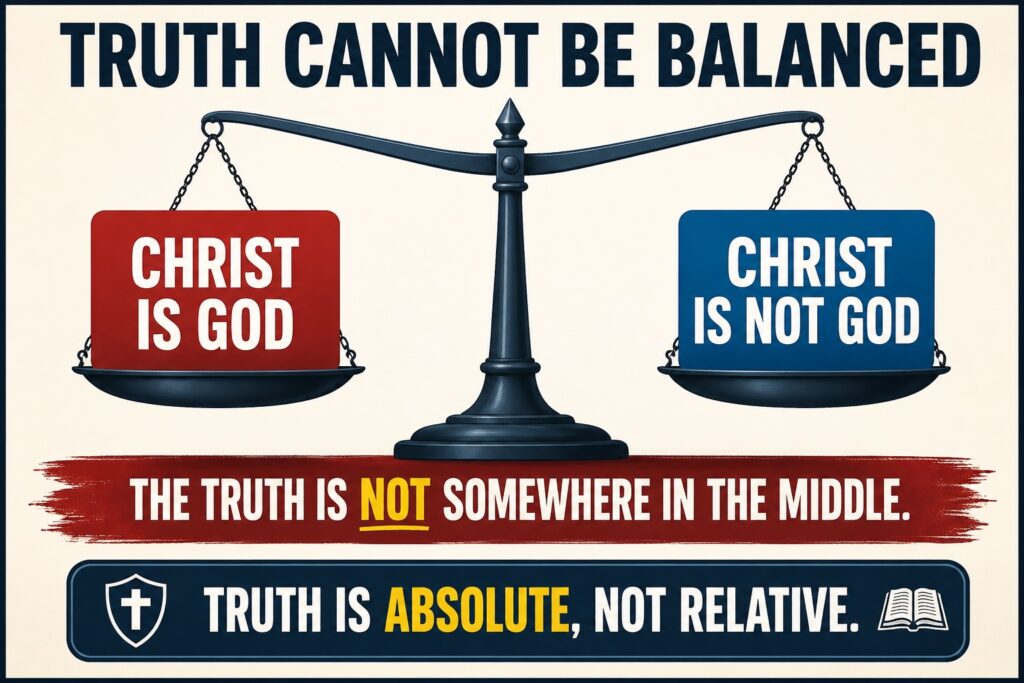
We may compare opposing concepts, but we cannot balance truth. That is inherently irrational. The fundamental principle behind all logic is that whatever is true cannot be false at the same time. In philosophy this is called “A is not non-A” and means that a thing cannot be itself and not itself at the same time. Without this simple principle, logic is impossible. Consequently, any given truth can’t be itself and its opposite simultaneously. Truth, therefore, cannot be balanced.
Can there be different facets to the same truth? Certainly. The deity of Christ is an example. It involves the virgin birth, the relationship between Christ’s two natures, His preexistence, and so forth. But this truth can never be balanced, since it would involve an absurdity such as “Christ is God versus Christ is not God…and the truth lies somewhere in the middle.” Some issues are not negotiable. One of them is that truth is absolute and not relative to any individual.
Absolute truth and doctrinal controversy
The early Christians understood that absolute truth is worth fighting for. In Acts 15, this understanding resulted in a dispute with the Judaizers. Some acknowledged that salvation is by grace alone. Others claimed it is by a mixture of grace plus law. How fortunate this dispute didn’t take place in the twenty-first century! Invariably someone would have declared, “Well, I can see Paul’s viewpoint. But the circumcision party has some excellent thoughts, too. I think the truth probably lies somewhere in the middle. After all, let’s not go to extremes. We may never know for sure anyway. In the name of brotherly love, let’s all agree to disagree and go home in peace.”
Imagine the result if the Reformers had held to relativism. Picture Martin Luther saying, “I believe in justification by faith. But I know some good folks who don’t agree. If they’re sincere, it doesn’t really matter what they believe. After all, we must be careful not to create divisions.”
Luther, Calvin, Knox, and their contemporaries had a notion that sounds extreme to many today. They felt truth was not only absolute but worth creating division over. Yes, even dying for. They seemed to feel that if we are sick of doctrinal disputes, then we are sick of truth. And if we’re sick of truth, then we are sick indeed.
Relativism as christianized atheism
Another problem with relativism is that it is atheism in disguise. If God exists, then truth must be relative to what he is. The buck stops there.
So when a Christian is thinking like a relativist, he is practicing Christian atheism. The blatant contradiction is there, whether he sees it or not.
Relativism and church discipline
Relativism in the church reflects itself in a lack of church discipline. Fornication has become so widely accepted in American society at large that it is viewed as morally acceptable, rather than the scandalous immorality it is. The Bible makes it clear that unrepentant fornicators do not go to heaven. Revelation 22:15
In one church, evidence existed that some members were participating in the Lord’s Supper who may have been living in fornication. The leadership seemed more concerned about what other churches tolerate and what the participants felt when they took the communion than the plain teachings of the word of God. Relativism in a Christian disguise.
Feelings versus biblical truth
A pastor describes counseling a church member who committed adultery. The member began talking about his feelings, not remorse but how the relationship evolved and how he felt about it. The pastor told the member that if he wants to talk about feelings, he had better start with God’s feelings first, which, for the moment, is pure wrath. And if he wants God’s feelings to change, his feelings had better be those of deep grief, remorse, and repentance. He is welcome to trash any other feelings as irrelevant.
Good pastor! Influenced by the word of God and absolute truth, not relativism!
Relativism in Bible interpretation
Theologian R.C. Sproul recalls an incident during a Bible study in which each person expressed what he or she felt the particular passage meant to him or her. Sproul said, “I don’t care what it means to anybody. I want to know what it means, period!”
Sproul was rightly rejecting relativism in a group of Christians. He understands that if two believers disagree on the interpretation of a verse, at least one is wrong, possibly both.
Reason-based rules of interpretation enter in at this point. By applying these rules to any text, we can come to the truth on most questions of interpretation.
True, some secondary issues are difficult or appear obscure. Martin Luther acknowledged that some things seem unclear but added that the obscurity is in us, not in the word of God. The Lord gave us light from heaven, not darkness.
A Christian should never utter the statement, “That is just your interpretation.” It implies that the meaning of scripture may be divorced from fact, reason, scholarship, and the rules of interpretation. This is a Christianized form of relativism which essentially states, Your view is a subjective perception, and since truth is merely a matter of perception, then it has no absolute value. While the speaker does not articulate those words, the concept is present: an ungodly worldview expressed through a Christian filter.
Legitimate differences of interpretation
When evidence is lacking to nail down the truth with certainty, then varying opinions are legitimate. That is not relativism. It is being open-minded toward the possibility of future evidence that will help establish a truth as absolute.
Passion for absolute truth
Relativism sometimes reflects itself in a lack of passion for truth.
In one conversation, a believer insisted, “Different groups have different opinions on that subject.”
What does that mean? Does it mean the truth is unknowable just because opinions differ? If such a proposition were rational, we would have to abandon all knowledge whatsoever.
When I preach, I start by saying something like, “We are going to study some truths from the word of God. These truths are absolute, universal, eternal, and final, not relative to any individual.”
I do this to contribute my perspective to the ongoing struggle for truth in the minds of the listeners. I know they have spent an entire week at the workplace, at school, or with entertainment media, being brainwashed into a view of truth that is self-contradictory, atheistic, and soul-destroying. I do this with the prayer that God will use not just my words but also his own words to help his people stand for absolute truth.
Exposing the contradiction in relativism
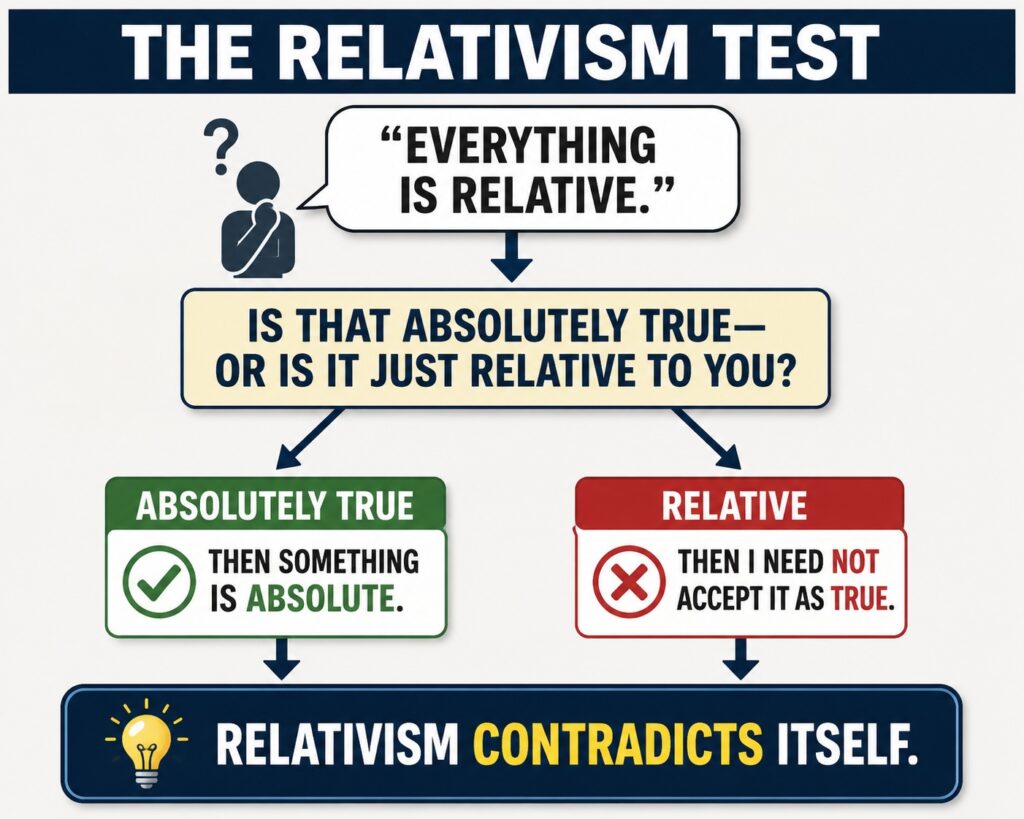
A simple way to expose the contradiction in relativism is to ask, “Is that absolutely true, or is it just relative to you?”
During a college class I attended, a liberal professor was commenting on a political issue. She made the statement, “After all, everything is just relative anyway.” I raised my hand and asked her, “Professor, is that absolutely true, or is that just relative to you?” I intended no disrespect but wanted to counter her influence on other students regarding relativism.
She realized the contradiction and was flustered. She replied, “Well, some things are relative and others are absolute.” I did not want to embarrass her further, but if I had, I could have asked, “Would you be so kind as to explain where you got the absolute standard by which to decide what is absolute and what is not, and what is the absolute authority for that standard?”
Teaching children to resist relativism
How can parents prepare their children to resist the current cultural brainwashing? Many parents seem to feel that teaching kids the gospel at an early age, along with a good catechism, is sufficient. Wrong.
At the risk of seeming sacrilegious, I am declaring those measures insufficient. When the children become old enough to interact with social media and go to school, the relativistic brainwashing will start. At some point, they will hear, “That’s just your personal perspective.” If they are not trained early on why that statement is absurd, parents will hear it from their kids later when they try to talk about absolute moral truth.
This is one reason Christian apologetics should begin earlier than many parents suppose.
Why catechism alone is not enough
An excellent catechism is the Westminster Shorter Catechism, used by millions of Christians since it was written in 1648. It was sufficient until now. The issue then was defining the truth about the gospel, not whether truth exists at all. For today’s kids, it does not start at the point where it is needed.
Preparing children to defend absolute truth
Some years ago, I wrote a short document to stimulate thinking about how parents can prepare their children to confront today’s relativism. I call it a pre-catechism. In it, I have 12 questions having to do with truth and the proof of God’s existence. Children can understand them since they contain no scholarly terms nor are philosophically difficult.
Other material better than mine could be written for this purpose. This is not the challenge, however. The challenge is getting parents to see the need.
The future of the church and truth
Days of persecution are coming. Christians who think more in terms of personal perspective than absolute truth may stumble because the ground under them is their own feeble perspective, not absolute truth.
###
Free books, essays and study guides
Related articles
What is Logic?
Who Created God?
Apologetics for Kids
Joyfully Justified: A Study Guide
If you liked this article you may enjoy our book,
Creation, Conscience and Christ: The three C’s of biblical apologetics