Faith, phobias and fantasies
Who is the Holy Spirit? Scripture reveals him as fully God and a distinct person of the Trinity who applies Christ’s saving work to believers. This study guide examines his person and ministry and explores controversial questions
about his filling, power, and spiritual gifts.
***
About this study guide
This teacher resource provides a biblical study of the person and work of the Holy Spirit. It considers his place in the Trinity, his ministry in salvation and Christian living, and differing views concerning the baptism and filling of the Holy Spirit. It also examines the continuing debate over spiritual gifts, including prophecy, healing and tongues.
What the complete guide covers
- The Holy Spirit’s place in the Trinity
- His person, deity and ministry
- Baptism and filling with the Holy Spirit
- Reformed and Pentecostal perspectives
- Continuationism and cessationism
- Prophecy, healing and tongues
- Biblical criteria for evaluating spiritual gifts
***
Introduction
…the fellowship of the Holy Spirit be with you all. 2 Cor.13:14
If we have fellowship with the Holy Spirit, the more we understand him, the better the fellowship. A study of his person, power, and gifts will help us walk by the Spirit as the apostle Paul urges us to do. (Galatians 5:16)
More controversy about the Holy Spirit exists today than in any other period in church history. How do we answer questions that inevitably arise?
A study of everything about the Holy Spirit would take volumes. As a minister with a focus on Latin America, I will emphasize issues relevant to that context.
In the study of the Holy Spirit, theologians use the term “pneumatology,” from the Greek word “pneuma,” meaning “spirit.”
Part one deals with the identity of the Holy Spirit and how he relates to the other members of the Trinity, to the world, and to believers. How to refute common errors about him will be presented.
Part Two deals with hot topics. With the emergence of the Pentecostal and Charismatic movements, debates about the workings of the Holy Spirit and spiritual gifts have come to the forefront. What is the baptism in the Holy Spirit? Are miraculous spiritual gifts for today?
Part Three deals with spiritual gifts, in particular three of the most controversial: prophecy, healing, and tongues. The author holds to a moderate view: such gifts exist today but not with the same frequency or purposes as in the apostolic age. Although this bias is evident throughout the study, the author attempts to present other views as heard from their exponents. Students are free to disagree without effect on their grade.
Inferential logic
Certain important biblical themes lack a direct discourse in Scripture, such as the Trinity or even some of the data on the deity of Christ. We infer the truth from clues in discussions of other topics. We call this “inferential logic,” meaning we draw conclusions by gathering data on the subject. If the evidence is sufficient, the conclusion is as valid as though stated in plain language.
So with pneumatology. We gather data about the Holy Spirit from things he does to people in the Bible, along with comments from apostles about him in the context of the spiritual welfare of believers and the growth of the church.
Chapter 1: His place in the Trinity
Studying the Holy Spirit is impossible without first understanding the Trinity. His identity lies as the third member of the Trinity, making it crucial to grasp the Trinity before delving into the Holy Spirit.
When examining the Trinity, we categorize its attributes into two distinct groups: communicable attributes and incommunicable attributes.
Communicable attributes refer to qualities of character and personality that can be shared with finite beings like us. These include holiness, love, patience, passion, and other attributes of God’s character that he communicates to us.
Incommunicable attributes are those qualities that cannot be in common with a finite entity. The primary incommunicable attributes are omniscience, omnipotence, and omnipresence, which are eternal and infinite. Other incommunicable attributes exist, but these are the most significant when discussing God’s attributes.
Understanding the identity of the Holy Spirit hinges on recognizing that he possesses all the same attributes as God the Father, making him fully divine. Despite being the third member of the Trinity, this does not diminish his essence or existence compared to the other members. Labeling the Trinity in this order is a concession to our limited comprehension, which we will explore throughout this study.
We see these attributes at play in God’s activity in his plan of salvation. God the Father rules, the Son purchases our salvation, and the Holy Spirit applies it. In creation, the Father is the architect, the Son is the builder, and the Holy Spirit breathes life into it. Yet we see a constant overlapping of attributes and activities throughout Scripture.
The Holy Spirit is not a mystical, non-intelligent force, as some teach.
Ontological vs Economic
The ontological Trinity
This term comes from the Greek ontos, which means “being.” It deals with two main questions when we discuss the Trinity: What are the members of the Trinity in their being? And how do they relate to one another?
False cults are quickly identified by the above questions. For example, Jehovah’s Witnesses claim that the Holy Spirit is a mystical, impersonal force emanating from the Father. This is a denial of his eternal nature as well as his equality in authority with the Father.
The ontological approach also emphasizes the oneness of God. There is one God, not three. This seems counterintuitive, but it is mathematically sound. Example: 1x1x1=1. No matter how many times the number one is multiplied by itself, the answer is always one. Therefore, the idea of three in one and one in three, without each being a third of the whole, is logically sound.
Hear, O Israel: The LORD our God, the LORD is one. Deut. 6:4 (ESV)
The economic Trinity
This addresses how the members relate to us, especially with regard to the salvation of the elect. The Father sends the Son to pay the cost of salvation, and the Holy Spirit applies it to the believer. These roles are distinct, though overlapping, so that by their very nature they require a hierarchy of authority.
Equal in authority: The Son and the Holy Spirit are subordinate to the Father in regard to their functions. This refers only to function, not personhood. John 5:18 ; Philippians 2:6
The Son is eternally engendered by the Father; begotten, not made. (John 1:18; Romans 1:3) The continuous present participle is used in Greek in Romans 1:3, genomenou. This means he is not a created being and is not inferior to the Father.
Looking at the Trinity from these two perspectives simultaneously keeps our theology in balance. Heresies regarding the Trinity stem from imbalances in the ontological-economic perspective. The parallel of unity versus diversity is probably the best approach for our limited understanding. This helps us see the place of the Holy Spirit in the Trinity.
Historic orthodox view
The Athanasian Creed, named for the fourth-century bishop Athanasius, was written around the fifth century and has been adopted by Catholics and Protestants as the best expression of the Trinity.
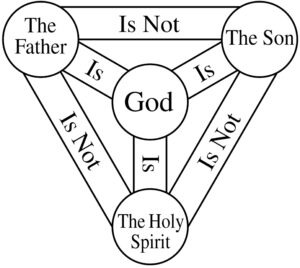
The doctrine of the Trinity balances two extremes. God is one in essence but three in person. Each member of the Trinity is equal in power, dignity, and authority. Yet each member is not one-third of the whole. The “shield” of the Athanasian Creed depicts it well:
***
About the author
Dr. Roger Smalling and his wife, Dianne, are missionaries to Latin America with the Presbyterian Church in America, a theologically conservative branch of the Reformed movement. They are dedicated to training Latin American Christians in principles of biblical leadership and sound theology.
Roger teaches extensively throughout Latin America by Zoom as a professor with Miami International Seminary.
Study guides, essays, and courses written by the Smallings are available on their website in both Spanish and English at: www.smallings.com
Continue with the complete study guide
The complete Who is the Holy Spirit? study guide continues with the person and work of the Holy Spirit, baptism and filling with the Spirit, and the major Christian views concerning prophecy, healing, tongues, and other spiritual gifts.
Download the complete Holy Spirit Study Guide (PDF)
63 pages • 17 chapters • Includes bibliography and index