This justification by faith study guide provides teachers with a nine-lesson course on the biblical doctrine of justification. Based on Joyfully Justified, it includes
teaching notes, discussion questions, exercises, quizzes, and answers.
Roger Smalling, D.Min
About this study guide
This Teacher’s Guide accompanies Joyfully Justified and provides a structured course for teaching justification by faith from a biblical and Reformed perspective. It combines doctrinal instruction with questions, group exercises, quizzes, teacher notes, and practical application.
What the complete guide covers
- the importance and meaning of justification;
- the covenant of works and covenant of grace;
- imputation and the righteousness of Christ;
- the active and passive obedience of Christ;
- the nature of saving faith;
- the benefits and practical results of justification;
- errors concerning justification; and
- a final review of the doctrine and its implications.
Lesson 2: Definitions and background
Corresponds to Chapters 2 and 3 of the textbook Joyfully Justified.
Objective
Define the term “justify” and show the reason for its necessity through the covenant of works and the law.
Definition
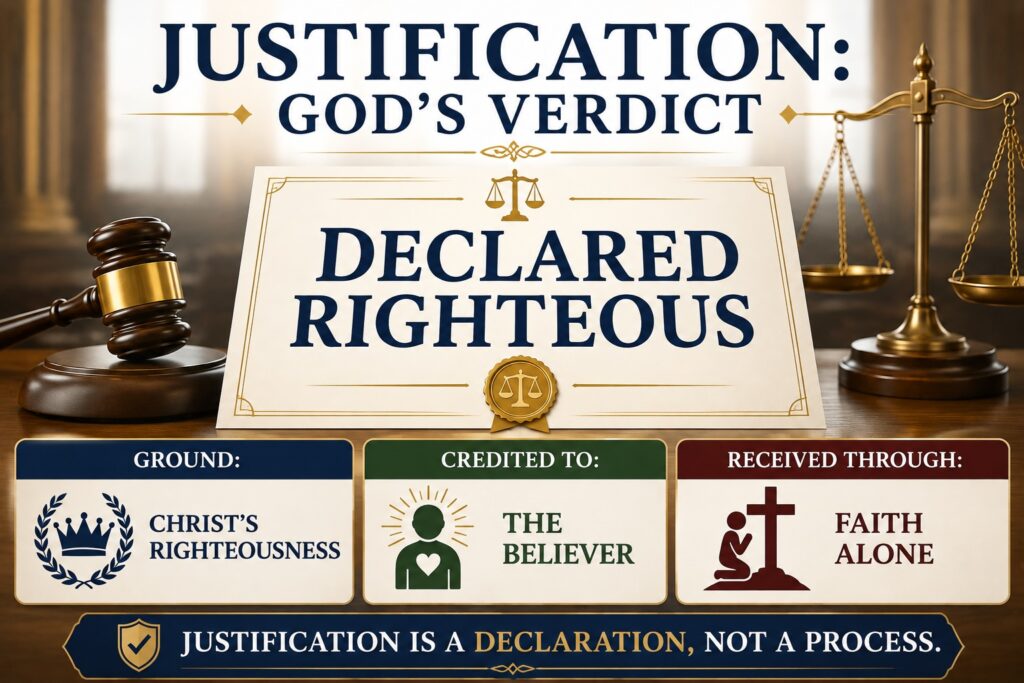
Justification is a legal declaration by God that a person is righteous compared with his law. The grounds is the perfect righteousness of Christ, imputed by faith alone, in Christ alone.
- It is a legal declaration from God.
- It is involved with God’s law.
- Its basis is the righteousness of Christ.
- That righteousness is credited to the believer.
- The means by which it is credited is faith alone
Does justification mean “made righteous” or “declared righteous”? Luke 7:29; 16:15;
1 Timothy 3:16
- Justification means declared righteous.
- Justification does not mean made righteous.
Therefore, justification is not a process. It is a divine declaration from God, the moment a person puts faith in Christ.
Here, the teacher can use an illustration in which he describes that it is logically impossible for a judge to make a partial decree of “not guilty” of a suspect. The decree is either “guilty” or “not guilty.”
Biblical Anthropology: Genesis 1:26,27
- What is the status of mankind before God? Image of God
- Did humanity lose its status as the image of God after Adam fell? James 3:9
Yes _____ No __X__
Explain here that many things can happen to a statue which represents a noteworthy person: it can be stolen, broken and get dirty. But it still remains a representation of that person. Therein lies its value, despite its condition.
Covenant of works: Westminster Confession, Chapter 19, Article 1
God gave to Adam a law, as a covenant of works, by which He bound him and all his posterity, to personal, entire, exact, and perpetual obedience, promised life upon the fulfilling, and threatened death upon the breach of it, and endued him with power and ability to keep it.
What is a covenant?
A covenant is a contract between two parties. The Bible uses the term covenant because of the particular nature of the relationship between God and man.
Two possible kinds of covenant
SUNTHEKE: An agreement between equals.
DIATHEKE: An agreement between a benefactor and beneficiary, such as the adoption of a child.
What elements are necessary for a contract to be valid?
- Identity of the participants
- Benefits
- Conditions each party must fulfill
- Termination: How long does the contract last?
- Validation: How to confirm that the contract as legitimate. In today’s society, signatures validate a contract. In ancient times, it was by vows or by witnesses.
The question of obedience
- What degree of obedience does God require? Matthew 5:18, 48; James 2:8-10; 1 Peter 1:15 Absolute perfect obedience
- What is promised for obedience? Leviticus 18:5; Deuteronomy 8:1; Proverbs 7:2; Matthew 19:7 Life
The disconnect between free will and responsibility: Romans 3:9-19
- Does God still require obedience despite human inability to comply?
Yes __X__ No _____
Discussion question: If the above is so, how can it be just?
Explain to the students that mankind remains the image of God despite the fall of Adam. His identity as image of God did not change. Therefore, his responsibility to God did not change either. Furthermore, the sinfulness of man does not remove from God the right to command what is just. The sinfulness of humanity is a chosen slavery. Therefore, God has the right to require obedience from man, despite human inability to comply.
Of Good Works: Confession of Faith, Chapter 16, Article 1
“Good works are only such as God has commanded in His holy Word, and not such as, without the warrant thereof, are devised by men, out of blind zeal, or upon any pretense of good intention.”
From this lesson we learn…
- Mankind is still the image of God, although fallen.
- The covenant of works is still in force and applies to everyone, everywhere.
- God requires perfect obedience as the condition for life.
- Partial obedience is disobedience.
- The moral law of God in the Old Testament is the only point of reference that God recognizes for moral terminology.
Quiz
True or false
- _____ God requires that the righteousness of the law be fulfilled in Christians.
- _____ Justification is a process.
- _____ Sanctification is a process.
- _____ God requires obedience from mankind despite man’s inability to comply.
- _____ God accepts partial obedience.
Answers
- T
- F
- T
- T
- F
Continue the course
Lesson 2 is one of nine lessons in the complete Joyfully Justified Teacher’s Study Guide. Download the full guide for the remaining lessons, teacher notes, exercises, quizzes, answers, diagnostics, and course syllabus.
Download the complete Teacher’s Guide—PDF
Elements of the Joyfully Justified course:
Textbook: Joyfully Justified
Teacher’s Guide: Joyfully Justified: Teacher’s Study Guide
Student’s Guide: Joyfully Justified: Student’s Study Guide
Note: A short, 8-lesson study for home groups and Sunday Schools is available here.
About the author
Roger Smalling, D.Min., served as a missionary and theological educator in Latin America, where he taught pastors and church leaders. His books and study guides focus on Reformed theology, Christian leadership, and practical ministry.