Is evangelical-Catholic ecumenism biblical? Should evangelicals unite with Catholics? Scripture teaches that unity must be grounded in the true gospel.
Roger Smalling, D.Min
************
Dear Roger,
In a ministry training seminar, the speaker declared we should associate with any Christian movement where the Holy Spirit seems to be moving and assist them. He included Catholicism in the groups mentioned as examples.
I felt uncomfortable because others have said Catholic-Protestant ecumenism is wrong. What do you think?
—Joe
<><><>
Dear Joe,
The speaker held to this premise: A sincere verbal profession of faith in Jesus Christ is sufficient grounds for Christian fellowship and unity.
That sounds charitable. It is also dead wrong.
The debate over evangelical-Catholic ecumenism ultimately centers on whether unity can exist without agreement on the gospel itself.
The ecumenist assumes a necessary condition is a sufficient condition. That’s like saying an engine is necessary for a vehicle to move without considering whether it has wheels. Both are essential. Neither by itself is sufficient.
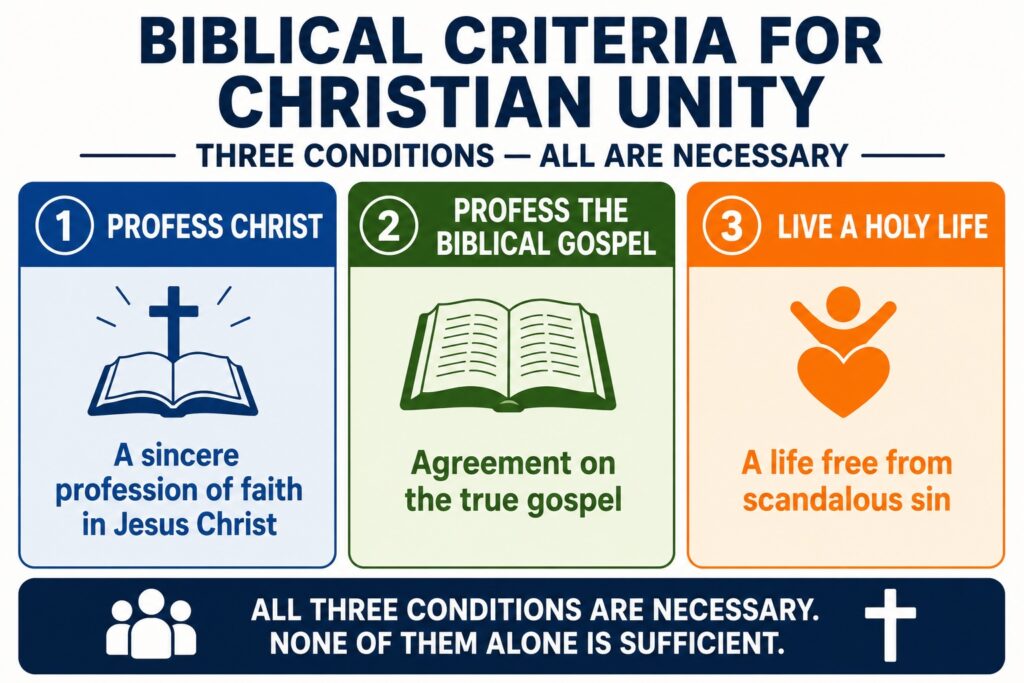
The New Testament requires three conditions for fellowship and cooperation in Christian work. The speaker’s premise is correct as far as it goes. Fellowship with those who lack a profession of faith in Christ is impossible by definition.
The gospel as the basis of unity
A person must profess the biblical gospel. Only one gospel exists, according to Gal. 1:5-6 …a different gospel—not that there is another one…
Throughout Galatians, Paul clarifies that justification by faith alone in Christ alone is the gospel. Any variation is a non-gospel, an anti-gospel. Those who hold to any other gospel are anathema, cursed by God.
Paul is normally conciliatory and benevolent. He sounds totally fed up here. Why?
Why Paul rejected Judaizers
Paul had to confront determined people who insisted Gentile converts observe the Law of Moses and be circumcised as a condition of salvation. Those we call Judaizers. They held to a formula: Faith plus works equals salvation.
Here’s the key question: Were the Judaizers professing Christians? Yes! They even had enough influence in the Jerusalem general assembly to cause a dispute over the question of circumcision.
Yet Paul would tolerate none of them.
A profession of faith is not enough
…to them we did not yield in submission even for a moment, so that the truth of the gospel might be preserved for you. Galatians 2:5
That alone explodes the ecumenist assumption that a profession of faith in Christ is sufficient grounds for unity. A profession of the biblical gospel is the second necessary ground.
Lifestyle and Christian fellowship
I am writing to you not to associate with anyone who bears the name of brother if he is guilty of sexual immorality or greed or is an idolater, reviler, drunkard, or swindler—not even to eat with such a one. 1 Corinthians 5:9
A life free from scandalous sins that would degrade the name of Christ is the third necessary condition for fellowship and unity.
All three are necessary. None of them alone is sufficient. If any are absent in a church, organization, or person, then it is incumbent upon a believer to avoid association with such.
Catholicism and justification by faith
How does this principle apply to Catholicism? The Roman Catholic Church holds to the same formula as the Judaizers: Faith plus works equals salvation. Catholicism simply adds a different set of works than did the Judaizers.
At the Anti-Reformation Council in 1545, Rome declared that anyone who teaches justification by faith alone and not also by works is anathema.
No fundamental difference exists between Rome and the kind of gospel the Judaizers were teaching. Both are anathema.
Faith plus works and the Judaizer parallel
The ecumenist holds unity as a supreme value. In the word of God, unity is strongly urged but never at the expense of truth. Nor is it higher than the three criteria mentioned above.
Division among Christians is an unthinkable evil in the mindset of the ecumenist. He is right. What he fails to grasp is that false gospels are infinitely worse.
The danger of ecumenical thinking
Much of the modern discussion surrounding evangelical-Catholic ecumenism stems from the tendency to treat unity as a supreme value. The ecumenist holds unity as a supreme value.
Ecumenists frequently mention the virtues of love and tolerance among believers as justification for their high esteem of unity. In the process, they tend to forfeit protection for God’s sheep from wolves.
Paul always urged us to avoid vindictiveness, even toward professors of false gospels. Though we must exhort, with complete patience and teaching (2 Timothy 4:2), we can only regard them as Christian brothers and pursue spiritual unity with them after they repent.
The teacher mentioned in your question above was wrong.
Roger
###
This article may be freely shared for ministry purposes.
For further study on justification by faith Joyfully Justified
Related articles:
Roman Catholicism: A Legitimate Christian Church?
Those who liked this article may enjoy our book in Kindle or Audiobook,
Joyfully Justified.