What is logic? Many assume it is merely a human invention, yet logic is actually
a fundamental aspect of reality that makes truth and knowledge possible.
Roger Smalling, D.Min
What is logic as a primordial reality?
There exists a small category of realities termed primordial. These require no proof of existence beyond themselves. Time and space are good examples. Empty space would exist even if nothing else did. We need not try to prove or explain them. They just are.
Time is another example of a primordial reality. If we define time as the relative rate of change between material objects, then it follows that time could not exist without matter. Or that the existence of matter forces the existence of time. The two are inseparable. It may be said that time is intrinsic to matter or that matter is the instigator of time.
Logic is also a primordial reality and bears the same relationship to existence as time does to matter. Logic is intrinsic to reality. It requires no justification for its existence because reality itself is the initiator of logic. The mere fact of the existence of anything at all automatically puts existence into a relationship with non-existence. This relationship is logic. Existence versus non-existence is the foundation of logic.
The foundation of logic
The foundation of logic is the proposition that a thing is what it is and is not what it is not. To understand what is logic, we must begin with this foundational principle.Aristotle put it formally as “A is not non-A at the same time and in the same relationship.” A tree is a tree and is not a non-tree. It is not a dog, a fish, or a cloud. That statement is both reality and logic at the same time. This basic law of logic is known as the Law of Non-Contradiction.
Nonsense can therefore be defined as non-reality. Sense is what corresponds to reality. It is the verbal or mental conception of the real world.
Occasionally we hear it said that the Greeks, Aristotle in particular, invented logic. No, he simply expressed it in comprehensible terms. Was everyone illogical before Aristotle?
Logic and objective reality
At this point, we must rectify a common misconception. When we discuss logic in this fundamental sense of existence versus non-existence, we are not referring to an activity of the mind. A star exists whether we perceive it or not. It bears a star-versus-non-star relationship with other objects regardless of anyone’s perception.
Most relativists and New Agers would take exception to this argument since they think no objective reality exists outside their minds. This argument is refutable by the rhetorical question, “Do any of their own objections have objective reality, or are these also figments of their own mind?”
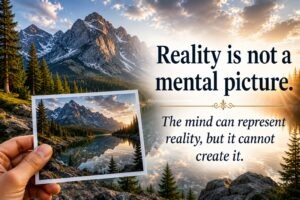 The difference between reality and the mind is the distinction between a landscape and a photograph of that landscape. The photo is not the landscape but merely a representation. In a sense, there is a mental conception in which the two are inseparable but not the same. Has anyone ever photographed a landscape that did not exist? The mind can only create representations of realities, not the realities themselves. Likewise, who would assert that a landscape does not exist merely because no one has photographed it?
Reality versus perception
So, the basic law of logic exists independently of the mind for the same reason that a star exists even when there is no mind to perceive it. We must keep it constantly clear that reality itself produces the basic law of logic, not the mind.
Because of this, logic requires no more validation of its existence than does time or space. As time and space require no external validation because existence is impossible without them, logic requires no external validation either. One would be foolish to try to disprove time’s existence, because he must take time to do so. He who attempts to invalidate logic is also a fool. One must use logic itself to do so.
All the statements below follow inevitably from this link between logic and reality. They require no other authority.
Why logic exists independently of mind
People may become confused about the relationship between the basic law of existence and mind because they tend to think of that law as a proposition.
A proposition in logic means a statement that forms the basis of an argument. But the basic law, as stated above, is not a proposition in this sense. It is simply a reality. Thus, some people, like New Agers, normally treat the basic law as nothing but an opinion, rather than the inescapable reality that it is.
Why logic requires no external validation
Why inescapable? Try thinking a single thought without logic. The mere existence of the thought puts it in a relationship with non-thought. This automatically involves the law of non-contradiction.
Logic is inescapable for another reason. We assume the conclusion of an argument is true if the premises are true. We do this simply because our minds cannot do otherwise.
Where, then, does the mind come in? It comes in at any point beyond the basic law of non-contradiction when we formulate a proposition. Logic enters because we cannot keep it out.
Logic is the only means for discovering or evaluating truth
Since the entire basis of logic is the fact of existence, we are compelled to use it to prove things. This helps answer the question, What Is Logic? in practical terms. This compulsion is not an accident of human nature, a mere philosophical choice, nor a product of our culture. We cannot avoid it if we are going to live in reality.
When we say “prove something,” we mean we can show things to be real, whether observable or not. We are saying if the premises are real and joined logically, then the conclusion must also be real. The subject of the conclusion must really and truly exist somewhere.
Conversely, when we say that a truth is proven, we mean we have shown a correlation between the proposition and the reality that the proposition represents. We have, in other words, used logic.
This is obvious enough. What is not apparent to some is that no other way could possibly exist to prove anything. Regardless of the source of our data, it must correlate with reality in some way, or we cannot accept it as real. Without this correlation, the mind must reject the data as unreal, that is, untrue. The mind must have a device for making this correlation, and that device is logic.
Even if we assert that other devices exist, such as a supposed divine revelation, we find ourselves embarrassed if asked, “What logic compelled you to assert that?” People who claim the existence of other devices for validating truth invariably use logic to validate that very assertion!
Why revelation still requires logic
Suppose, for example, that the source of the data is indeed divine revelation. Does this change the necessity of logic for validating it? Not at all. Even if the data is divine, the mind must correlate it with reality to understand or believe it.
Further, the data involved, however divine, is still subject to the basic principle of existence. It exists versus not existing. Its very existence subjects it to the first basic law of logic. Thus, divine revelation cannot escape this law any more than other data can.
Thus, when it comes to the need to correlate data logically, it does not matter that God’s mind is “higher” than ours, that our mind is derived from his, or that he is the First Cause. These are irrelevancies. Data is still data and must exist versus not existing.
Since no data, not even divine, can escape this basic law, it follows that logic is the only possible means of proving the reality of the data. It does not matter what kind of truth is being proven, whether divine or otherwise. If any other means of proof existed, then by definition it would be a non-logical or illogical means. Therefore, asserting that any means other than logic itself could possibly exist for proving any truth whatsoever makes no sense.
Logic and reason are not the same thing
At this point, another common misunderstanding intervenes. Just because a person thinks a line of argumentation is logical does not make it so. That would be like saying that a thing is real if a person imagines it to be so. Do flying horses exist because somebody believes they do?
The reason is the relative ability to manipulate correctly the laws of logic to arrive at valid conclusions. While the laws of logic are absolute, our ability to use them is not. This skill varies from person to person. We all make logic errors. This is not the fault of logic. It is a flaw in our abilities.
Sometimes people point to philosophers who have come to very strange conclusions via supposed logic. Supposedly such examples demonstrate that logic itself is not a very reliable means for asserting truth.
Christians, for example, point out atheistic philosophers and their reasoning as examples of how logic may fail to arrive at truth. Two problems reside in this attitude. First, it assumes the atheistic lines of reasoning are in fact logical. Closer examination invariably shows them irrational.
Second, some Christians forget that they themselves are attempting to use a line of logic to prove an argument. They are using logic to disparage the value of logic. There is a term in philosophy to describe this. It is called “cheating.”
We all commit logic errors. Voluminous books have been written on the many ways to commit logic fallacies. These fallacies do not prove logic is invalid. They only show that logic is not always easy. So what? This is a challenge to handle it carefully.
Truth and validity are not the same thing
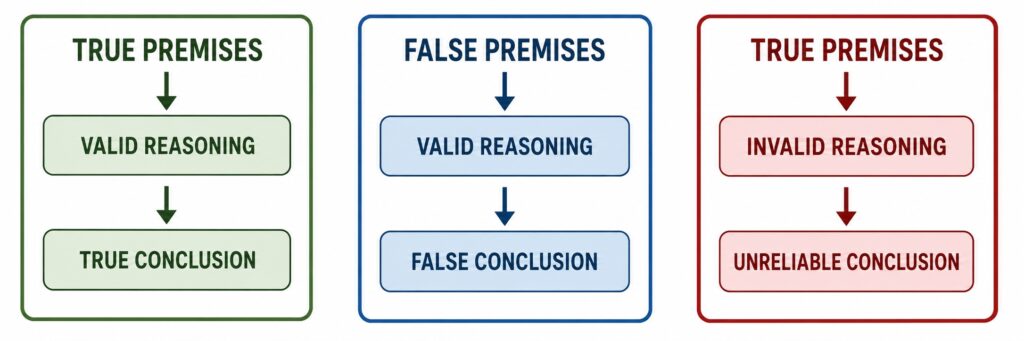
If the premises of a line of argument are joined consistently and the conclusion follows accurately, we say that the conclusion is valid. What if the premises are false? Does this affect the validity of the argument? Not at all. Logicians distinguish between validity and truth.
When we say that an argument is valid, we mean that its form is correct. This statement about validity is not an endorsement of its premises.
Example:
All men have ten fingers.
John is a man.
Therefore, John has ten fingers.
Suppose we meet John and discover that he has only nine. Does this invalidate the argument? No, because the form is correct. Is the conclusion true? Again, the answer is no, because the first premise is not true. (Not all men have ten fingers. Some may be lost in accidents.)
Thus, it is possible for an argument to be valid but untrue. It is also possible for the conclusion of an invalid argument to be perfectly true as well. People often come to true conclusions from a dubious line of logic. This is accidental, of course, but it does not change the truth of the conclusion. John may indeed have ten fingers, although it is false that all men do.
Failure to distinguish between truth and validity gets people into trouble. We may imagine ourselves to be logical because we come to a truth via logic, when in fact our logic may contain fallacies. Or we may come to firm conclusions, totally untrue, based on impeccable logic because we have accepted untrue premises.
God’s logic is not different from ours in its essential nature.
Understanding this point clarifies what is logic and why its essential nature cannot change.
God himself knows He can’t exist and not exist at the same time. This is just as much a manifestation of the basic law of existence as any other data. He exists versus not existing. Since this is the essential nature of reality, and if we say that God is the ground of reality as the First Cause, then it follows that the nature of God’s logic is not essentially different from ours.
Note that I said “different in nature.” I did not say it was different in content or different in precision. To reason at all requires data. The more data we have, the stronger the basis for true conclusions. The ability to correlate the data determines the accuracy of the conclusion (the absence of fallacies).
If God knows all things (possesses all the data) and is all-powerful (has infinite ability), then He never commits the logic errors we do. These issues of content and precision only are irrelevant to the question of the essential nature of logic itself.
The law of non-contradictions does not limit God
To suggest that the Law of Non-Contradiction limits God, we would need to demonstrate first that the Law itself is limited. Since the Law of Non-Contradictions is a reflection of existence itself, then the question of any limitations becomes absurd. We would have to associate it with something finite to make it limited. After all, existence and non-existence cannot coexist at the same time and in the same respect. How can that statement possess a limitation?
The only other way to limit the Law of Non-Contradictions would be mathematically. If the number of possibilities is finite, we would conclude God is not limited by it, since He is infinite. However, no one has shown a mathematical limitation on the Law of Non-Contradiction.
Thus, the question, “Is God limited by the Law of Non-Contradictions?” simply has no meaning.
The basic law of logic must exist if anything at all exists
If anything exists, even if that anything is God alone, then logic exists by the nature of the case. The existence of God then bears a relationship to the idea of the non-existence of God… and that incurs logic.
Does this make logic superior to God? Since God is the ground of all reality, it is absurd to say logic is superior to Him. This is true, even though logic is a primordial reality, like infinite space.
Logic is the only valid starting point in our understanding of anything, including God
Some branches of Christendom would consider this statement to be sacrilegious. Faith is supposed to be the beginning point of everything having to do with God. This may sound correct, but it contains a problem. Which organ of our anatomy decides that faith comes first? The mind makes this decision and operates by logic. Therefore, faith is chronologically secondary to understanding anything, including God.
Nevertheless, chronological priority does not infer supremacy. Logic is first but is not superior to God.
True knowledge of any kind, including the knowledge of God, therefore starts with logic. It cannot start anywhere else.
It is therefore the ultimate absurdity to assert that no true knowledge is available without first assuming the existence of God. Such an assumption makes true knowledge impossible. It denies the priority of logic and therefore of reality itself.
Where, then, does faith come in if we define faith as a form of trust? Logic may point a person toward faith, but it can go no further. Trust then becomes a question of will. That is another subject beyond the scope of this essay.
Is the dialectic a form of logic?
No. The dialectic is a form of illogic.
Hegel’s dialectical method
The German philosopher Hegel (1770-1831) invented a supposedly superior form of reasoning, which would revolutionize philosophy. Its impact has truly been revolutionary. It forms the philosophical basis for dialectical materialism, more commonly known as Communism. Liberal Protestantism uses it to deduce its various theories. Theologian Paul Tillich called it “The Protestant Method.” In philosophy, the dialectic is the foundation for relativism and all the postmodern thought forms stemming from it.
The dialectic follows a triangular pattern:
Thesis→Antithesis→Synthesis
The thesis refers to any proposition affirming a truth. (“White is a good color.”) The antithesis is the opposite of the thesis. (“Black is a bad color.”) The Synthesis is a blend of the two. (“Gray is better than both.”) The synthesis then becomes a new thesis, which produces a new antithesis, ad infinitum.
A more concrete example:
Thesis: Christianity has some good elements in it.
Antithesis: Communism has some good elements also, though opposed to Christianity.
Let’s take the best elements out of each and come up with something superior to both.
Result? Synthesis. The Social Gospel of Rauschenbusch. Or the Liberation Theology of Gutierrez. These men arrived at their so-called theology in exactly this fashion and said so in their writings.
Why the dialectic fails as a standard of truth
On the surface, the dialectic seems a reasonable process. How then can we say it is a form of illogic?
No external standard exists to decide what is good or bad in the propositions. Who defines the good? Where did this standard originate, and what is the authority for it? Nothing within the dialectic gives clues.
What methodology should we use to validate the dialectic? The Law of Non-Contradictions? Of course! What else is there? We could not use the dialectic itself because this would incur circular reasoning.
At this point, the dialectician invariably replies, “The individual decides.” Why an individual? Why not two individuals, or ten thousand, or none at all? Why not a roulette wheel?
The problem with the dialectic is that it cannot validate itself in the same way the Law of Non-Contradictions can. Dialecticians invariably use the Law of Non-Contradictions for this purpose, thus contradicting themselves.
The self-validating nature of logic
The Law of Non-Contradictions is self-validating in a way that the dialectic can never be. It is consistent to use the Law of Non-Contradictions to validate itself because of its intrinsic connection to reality.
Summary
The nature of logic is reality itself, due to the fact of existence. If someone asks, “What is logic?” the simplest answer is that logic is a systematic reflection of reality itself.
Anything that exists does so in relation to non-existence, and this is the essential premise of logic. A denial or disparaging of logic in any sense is, therefore, a denial or disparagement of reality itself. Where does it leave us if we deny reality?
No truth, therefore, can be discovered or evaluated without logic since the term “truth” is merely an assertion about reality. Logic is not only the best means of evaluating truth but also the only one that could exist.
Likewise, only truths that take logic as their starting point can be evaluated, discovered, or considered valid. Knowledge cannot be true knowledge if it starts from any place other than logic.
This is just as true of the knowledge of God as it is of any other knowledge. Even if data comes from revelation, the mind must correlate it with logic to understand it.
Logic becomes indispensable for the same reason we cannot dispose of reality itself without forfeiting our existence.
The essential nature of logic, therefore, can be described as a primordial reality that requires no other validation than reality itself. This is ultimately the answer to the question, what is logic.
###
This article may be freely shared for ministry purposes.
For further study:
Creation, Conscience, and Christ: The Three C’s of Biblical Apologetics
Related articles:
Those who liked this article may enjoy our book in Kindle or Audiobook,
Creation, Conscience, and Christ: The Three C’s of Biblical Apologetics