Servant leadership does not mean surrendering the biblical rights
of Christian ministers. Scripture establishes protections
that safeguard their calling.
Roger Smalling
This essay is an excerpt from the book,
Christian Leadership: Principles and Practice
Servant attitudes and integrity, along with a disposition to embrace suffering, characterize biblical leadership. There is a flip side to this coin.
According to Scripture, God’s ordained leaders have certain rights and privileges that no one may disregard without due process.
Our current culture tends toward independence, individualism, and a distrust of institutions. These attitudes may lead to a disregard for the spiritual authority God grants ministers. If church members submit to him, they may do so because they like him, not because they respect his office or acknowledge his spiritual authority.
Worse, we as ordained ministers may inadvertently violate the rights of our fellow ministers. We may end up treating our colleagues as less than what the Word of God says they are. If we understand the rights of ministers, we can avoid treating our fellow ministers unethically. Some of these rights and privileges are the following:
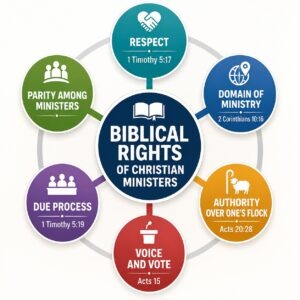 The right to respect
1Tim. 5:17. Let the elders who rule well be counted worthy of double honor, especially those who labor in the word and doctrine.
The preaching and teaching of the Word is central to Christian ministry, so we must honor those called to it. This includes avoiding derogatory remarks about a fellow minister.
There are exceptions, nevertheless. We have the right and mandate to speak against heretics whether they call themselves ministers or not. In fact, these are not fellow ministers. Rom. 16:17-18
Disciplinary cases involving ministers are another exception. Evaluating a fellow minister for future work is also an exception. Negative evaluations may be correct in such a setting.
We treat fellow ministers as equals, because that is what they are before God. In reformed ecclesiology, there is no other rank higher than the ordained minister in this dispensation. Some ministers have earned more respect than others because of their experience or accomplishments. But under no circumstance are we to treat any minister as less than a minister of Christ.
Conversely, this principle means ministers have a right to defend themselves against abuses from others when necessary to do so for the honor of the gospel. This is the entire point behind 2 Corinthians as well as 1 Corinthians Chapter 4. Paul had to defend against a disdainful attitude from the Corinthian believers. He did this not for himself alone but for the honor of the gospel and because their attitude was sinful.
Being a servant predisposed to suffering does not always mean a leader must let himself be walked on. When the honor of the gospel is called into question, he not only has a right to defend himself; he has that obligation.
The right to a domain of ministry
2 Cor. 10:16: “…to preach the gospel in the regions beyond you and not to boast in another man’s sphere of accomplishment.”
Rom. 15:20. “And so I have made it my aim to preach the gospel, not where Christ was named, lest I should build on another man’s foundation.”
Even the Apostle Paul recognized the concept of ‘territory’ in ministry. Every minister has his ‘sphere,’ and we respect it. If a minister is working in a certain area, we avoid infringing. We refrain from building our church next door to another legitimate evangelical work. We avoid evangelizing in villages where others are already doing so. By the term ‘another man’s foundation,’ Paul recognized that others have ownership of the ministries they have founded.
The right to authority over one’s own flock
Acts 20:28. “Therefore take heed to yourselves and to all the flock, among which the Holy Spirit has made you overseers, to shepherd the church of God, which He purchased with His own blood. (29) For I know this, that after my departure savage wolves will come in among you, not sparing the flock.”
The Holy Spirit gives a particular flock to each minister to shepherd. From this passage we deduce certain ethical principles.
We do not steal sheep from another minister’s flock. Some consider themselves and their denominations so superior they feel justified in taking people from other legitimate evangelical groups. This is a religious form of thievery.
Freedom from accusations without due process
1 Tim. 5:19 Do not receive an accusation against an elder except from two or three witnesses. (20) Those who are sinning rebuke in the presence of all, so that the rest also may fear.
Judgment by ministerial peers
Due process means some hearing before one’s ministerial peers by which a minister can answer accusations made against him. According to the above text, this right includes at least two things.
The requirement for witnesses
No congregation has the right to receive accusations against a minister. Timothy, not the congregation, had the authority to receive accusations against the elders. Even then, substantial eyewitness evidence is necessary.
The burden of proof
The accused ministers have nothing to prove. All the burden of proof is on the accusers. If they fail to substantiate their accusation, they have committed slander and must be rebuked.
The right to voice and vote
We would think such a right is self-evident. It is astonishing how it is overlooked.
A Christian hierarchy will usually treat its workers more like employees than fellow ministers. The biblical rights of Christian ministers can get washed overboard in the maelstrom of bureaucracy.
Example: A mission board was writing its policy manual. They considered how to obtain a correct perspective of crisis situations on missionary teams. They adopted the following policy: “Perceptions of reality shall be those of the team leader.”
This absurd statement assumes the leader could never be the cause of the crisis, his perceptions are always accurate, and the other ordained ministers on the team may safely be disregarded.
We see in several instances how even the apostles avoided imposing authority over ordained elders. They recognized that others had the right to consult them in matters affecting them. Examples:
- At the Jerusalem council, Acts 15, all the elders present had voice and vote, even though they were not apostles.
- To Philemon, Paul says, “But without your consent I wanted to do nothing, that your good deed might not be by compulsion, as it were, but voluntary.” Philemon 1:14
- As an apostle, Paul could have given orders. He didn’t.
- Consistent with Christian leadership style, Paul refused to bypass Philemon’s domain of influence.
- Regarding Apollos, Paul says, “Now concerning our brother Apollos, I strongly urged him to come to you with the brethren, but he was quite unwilling to come at this time” (1 Cor. 16:12). Paul ‘urged’ him but did not command him.
No one, regardless of their rank in a hierarchy, has a right to bypass an ordained minister by making decisions affecting that man’s ministry without granting him a voice in the matter. Doing so is discourteous and immoral.
The practice of parity among ministers
The ‘Pact’ among leaders
Two or more leaders can agree to defend each other when one is verbally attacked, especially in his absence. This presents a united front, which tends to silence critics. They learn that if they want to verbally attack your colleagues, they had better do it outside of your hearing.
What if the critic is correct in his assertion? Tell him the other ministers or leaders are capable of dealing with the matter.
God frequently defends the leader even when the man is wrong in a decision. It seems God defends His own honor in such cases because he is the one who appointed the man. Leaders must beware of pride at this point. Some leaders assume that a positive outcome means God approves of their decisions. Such thinking can be self-deception.
Integrity, not control
I control myself and do not allow others to control me. Is this attitude arrogant and independent? Not if integrity is the foundation of your relationships with those in authority over you.
“Control” is one way leaders might relate to people, but it is not a godly one. The godly way is on another basis: Integrity
Keeping agreements
When we make a promise, we keep it even when it is inconvenient. The psalmist says the man is blessed “who keeps his oath even when it hurts.” “Ps. 15:4. We keep our promises because we are made in the image of God, and He keeps His word.
Nothing is wrong with asking someone to renegotiate an agreement because of unforeseen factors. However, we lack the moral right to break it, even if we have the power or ‘authority’ to do so.
This is doubly true in relationships with ministerial colleagues. If you become a Christian leader in a powerful organization, the temptation may be to break inconvenient agreements simply because you have the power to get away with it. The power to do a thing and the right to do it are different issues.
I have observed how powerful organizations may view agreements as unilateral, binding only the weaker party and allowing them to change it with immunity. This behavior is simply another form of arrogance.
Beware of this human tendency if you become a leader in an influential organization. If you make agreements, do your best to keep them. Otherwise, it will erode your integrity, which ultimately means eroding your right to lead.
Accountability groups
Every leader needs to be accountable to somebody, whether the system they are in requires it or not. Pick out two, or at the most, three friends who will agree to be an accountability group for you. This means you will keep them informed of important issues affecting you and listen to their counsel.
Prov. 24:6: And in a multitude of counselors there is safety. (KJV)
A group may simply exist as an advisory committee to provide counsel when encountering difficulties in your ministry.
I have an advisory committee of this sort, consisting of a pastor and an elder. I formed this group several years ago while under attack from abusive leaders. Since I knew my emotional involvement might cloud my perception of reality, I chose two men to help me. These turned out to be more than merely helpful They were indispensable in a tough situation I could not have handled on my own. They went to bat for me when it counted.
The terms of my agreement with my personal committee are simple: I agreed to keep them advised of everything of importance that may seriously affect my ministry. This includes potential crisis situations as they may develop, along with any major changes in ministry. I agreed to only make important decisions with their counsel after very thorough consideration.
Tip: Be very careful to choose just the right men for such a committee. You want men with a certain indispensable quality: uncompromising moral courage. Without this trait, your committee is worthless.
Summary of ministerial rights
The biblical rights of Christian ministers include respect, freedom from accusations without due process, and authority over their domain of ministry. If we understand these rights, we will be better prepared to avoid sinning against our colleagues by violating them. Creating their own private accountability or advisory committee helps keep them on track and ethically sound.
From this article we learn the following:
- Those God appoints to leadership have certain scriptural rights and privileges. It is unethical to ignore these.
- Their spiritual authority and office must be respected, even though they are not always right.
- They are entitled to voice and vote in all matters affecting their ministry.
- Another important right includes freedom from accusations without due process.
- It is advisable for every leader to be accountable. This provision is a safeguard.
###
For further study:
Christian Leadership Training: Teacher’s Guide
Recommended Readings:
Dangers of Hierarchy in Christian Organizations
If you liked this article, you may enjoy our book in Kindle or Audiobook,