A young man once wrote asking, “Can a Christian lose salvation?” And what would be the rationale for my answer? The following is my reply:
************
Dear Paul,
Your letter was a welcome surprise. Not only are we interested in your progress and activities, but also it is a pleasure to engage theological subjects.
Before I can answer your question, we must define terms and establish parameters. The doctrine you described as “once saved, always saved” is more precisely termed “eternal security.” The opposing view is known as Arminianism.
Neither of these terms is adequate for various reasons. Arminianism refers to an entire system of theology of which the issue of losing salvation is only one aspect. “Eternal security” was a term popular among the reformers, but they did not mean it in the sense in which many Baptists use it today.
These two views are hotly disputed, as you know. However, these are not the only options. In fact, there is a third view, called the Doctrine of Preservation and Perseverance of the Saints. This third view is the one I hold and to which the reformers held, along with reformed churches today, such as Presbyterian, Christian Reformed, etc.
It is perhaps incorrect to call this a third view. The other views are, in fact, historical developments of this one.
Defining the three views
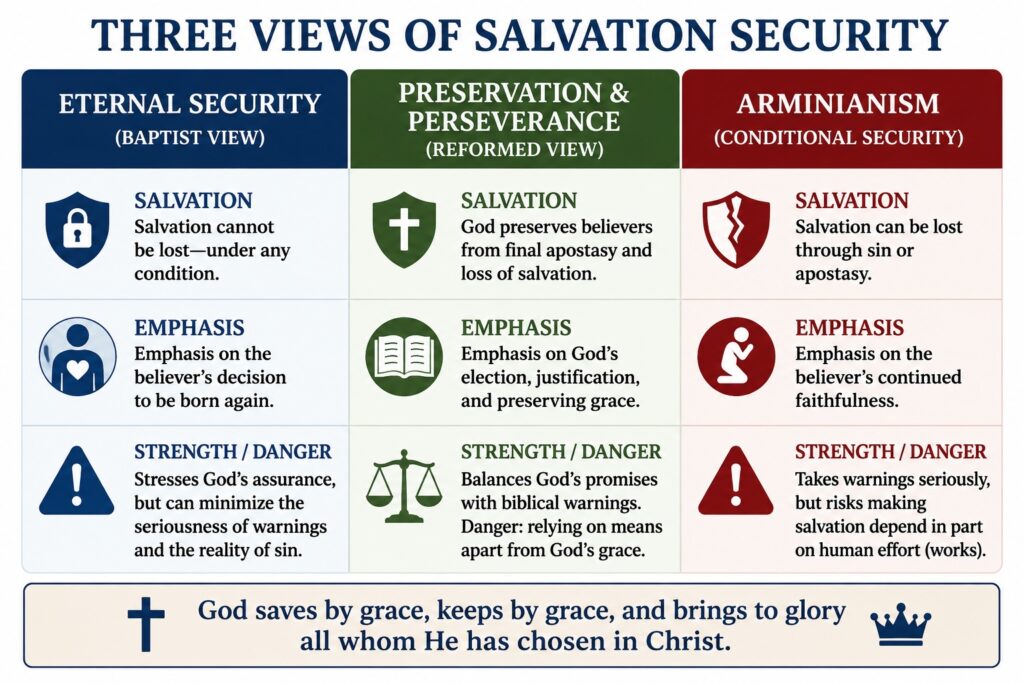
Eternal Security: The doctrine that a Christian cannot, under any condition, lose his salvation. God deposits the gift of eternal life in him and will not remove it, regardless of conduct or apostasy.
Arminianism: The doctrine that a born-again Christian may revert to a life of sin or apostatize from the faith and be eternally lost.
Preservation and Perseverance: The doctrine that God has an elect and justified people, chosen from before the foundation of the world, whom he preserves from ultimately and finally falling into any condition that would jeopardize their eternal salvation.
The reformed view of security
Though preservation is a gift of the grace of God, he uses practical means to ensure it. The primary means he uses is the believers’ own efforts at perseverance, which God stimulates through exhortation, warnings, chastisements, the Word, fellowship, and others. I will refer to this perspective as the Reformed view. (1)
How preservation differs from eternal security
Note that the Reformed view agrees with both of the other views in some respects and disagrees with them in others. It agrees with the Eternal Security (Baptist) view in that believers do not lose their salvation. Yet it states that conditions may exist under which a believer could lose his salvation. A life of sin or of apostasy is a fully legitimate condition by which a believer can indeed lose his salvation, and he must ensure he does not. But it insists that God preserves his people from actually fulfilling that condition.
The Reformed view also disagrees with the Baptist view regarding the basis of the believer’s hope. The Baptist view bases it on the believer’s choice to be born again so that God then grants him eternal life. Preservation and perseverance are based on the decree of God’s election and on justification.
The role of justification and election
Justification means God attributes the perfect righteousness of Christ to a believer, rejecting any accusations against him. (2) The Reformed view believes that the Baptist view places more hope in the will and activity of man than in God’s eternal decree.
In fact, this is also true of the Arminian view. Paradoxically, the Reformed camp sees the other two views as committing the same basic error but from different directions.
Does the Bible teach conditions for apostasy?
Preservation and perseverance agree with the Arminian view that conditions indeed exist by which a Christian could lose his salvation. The responsibility lies squarely on the shoulders of the believer to persevere via the means God has provided.
However, such a loss of salvation has never happened to any believer. The Arminian view commits a logic error at this point. Just because a thing is hypothetically possible does not prove it has ever happened or ever will. A fundamental principle of logic is that hypotheses are not facts.
At this point Arminianism leads to a false gospel, a doctrine that salvation ultimately depends, in part, on good works. That is heresy. (3)
It’s easy to see why the Arminian accusation that security of salvation provides a license to sin falls heavier on the Baptist view than the reformed one. After all, the former view denies that sin and apostasy pose any real danger.
Warnings and promises in Scripture
Warnings about the consequence of apostasy and sin exist in the Bible along with promises of eternal security. God is not kidding when he provides such warnings. There is no need to explain them away. The dangers are real. But neither is he hedging on His covenant promise of preservation. Doesn’t the Bible teach that God is sovereign, while man is also responsible for his actions? The reformers believed so and felt comfortable with both lines of verses.
With this being the case, we can ask ourselves if the verses you listed are really difficult to understand.
We need to establish some parameters along with definitions. We’ve touched on some definitions, and now we need to establish a parameter.
You notice the Bible does not state explicitly whether a Christian can lose his salvation. Conclusions must be drawn from the available evidence. Is it legitimate to conclude the Bible says something that scripture does not directly state?
Yes. Otherwise, we would have to abandon the Trinity, most of the evidence for Christ’s deity, our view of end-time events, and many other doctrines. Views not directly stated can be valid doctrine, assuming, of course, they incorporate all of the available evidence. (4)
Let’s ask ourselves which of the three options best incorporates the sum of the biblical evidence on this subject.
Understanding 2 Peter 2:20-22
Arminians assume these verses refer to born-again Christians. They also suppose an exhortation to avoid apostasy proves that some apostatized. This text should be understood only as an exhortation to avoid apostasy and its consequences, and it does not prove anything about what actually happens.
Further, there is a grammatical problem with the Arminian interpretation. Note the pronouns “they” and “them.” In grammar, a pronoun replaces a previously stated noun. If we carefully trace these pronouns back to their origin, we arrive at verse one:
But there were also false prophets among the people, just as there will be false teachers among you. They will secretly introduce destructive heresies, even denying the sovereign Lord who bought them—bringing swift destruction on themselves.
The identity of false teachers
Peter is referring to false prophets who have infiltrated the church, professing to be believers, who in actual fact are reprobates in disguise. The text in 2 Peter is not referring to born-again Christians.
What about escaping the corruption of the world through the knowledge of Christ? Monks have done that for centuries without being saved. A strong will, self-denial, and religiosity have produced a certain external righteousness in many ascetics who are now in hell.
Understanding Hebrews 10:26-31
The purpose of Hebrews
The Book of Hebrews occupies a special place. To comment on these verses and those in Chapter Six, we must consider the purpose of the book as a whole.
The author of Hebrews states his main point in clear terms. This understanding is a luxury for us. We realize in advance we must interpret every verse of Hebrews in accord with this point.
Here is what the author of Hebrews says is his main point:
Now the main point of what we are saying is this: We do have such a high priest, who sat down at the right hand of the throne of the Majesty in heaven (Hebrews 8:1).
This verse summarizes the author’s teaching in the previous chapters and introduces three chapters of detail on why everything in the Old Testament leads to his conclusions. What is the point? In Christ, our high priest, we have absolutely secure salvation through his infallible ministry of intercession for us.
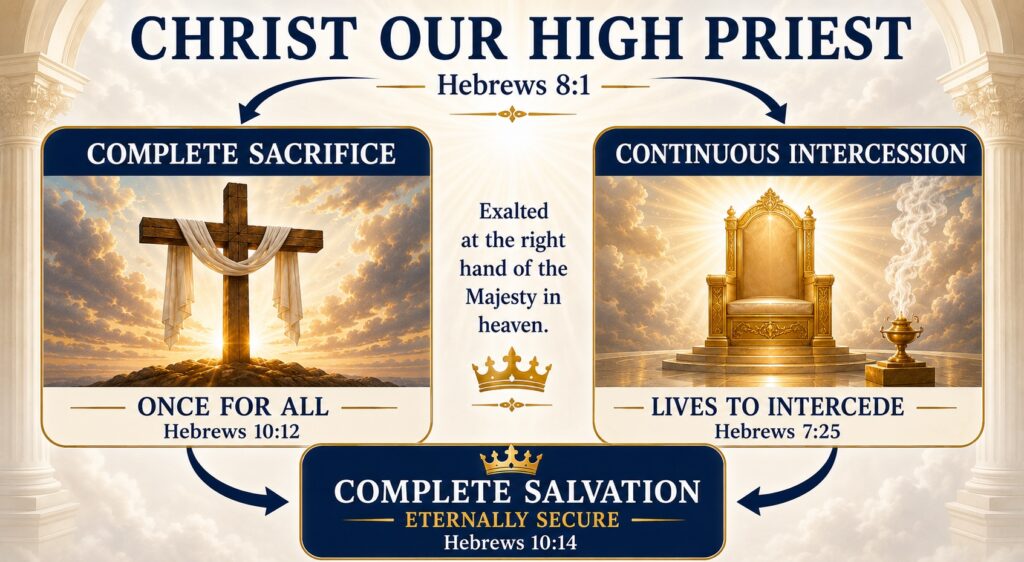 …because Jesus lives forever, he has a permanent priesthood. Therefore he is able to save completely those who come to God through him, because he always lives to intercede for them. Hebrews 7:24, 25
The ministry of Jesus as high priest, both in His completed sacrifice and perpetual intercession, is so effective that all who come to God through him are saved absolutely and eternally.
Therefore, no verse within the book of Hebrews can possibly refer to believers losing their salvation.

The writer was addressing a particular first-century problem among converts from Judaism. Some had one foot in the synagogue and the other in the church. They wanted both Judaism and Christianity. They attended church only occasionally. (5)
It’s difficult to tell whether they were saved or not. The intent of the writer is to warn those attempting to walk that kind of fence. Unless they left the elementary principles of Judaism and committed fully to Christ, there was no salvation for them. A mixture of law and grace could not save them. The above text addresses the danger of these people without the writer passing judgment on whether they are saved or not.
If this text means genuine believers lose their salvation, then we have a problem with v. 26. (Such a high priest truly meets our need—one who is holy, blameless, pure, set apart from sinners, exalted above the heavens.) The text proves more than the Arminian intends. If they assume he is talking to born-again people, then they must conclude that if a Christian sins after he is saved, he can never be forgiven. Such reasoning makes backsliding the unforgivable sin, without scriptural warrant. But no one seems to hold to this view.
The author is making a point in the most potent way possible. A Jew in the Old Testament was lost if he rejected the Law of Moses, and similarly, he cannot expect mercy if he rejects Christ.
How does one “trample” the Son of God underfoot and insult the Spirit of Grace? Those half-committed Jews were doing just that by returning to the synagogue and the Law. This insulted grace and implied that Christ’s blood was insignificant and that the Cross was not enough for their salvation.
The text is not directed at backslidden Christians but rather at Jews who professed to be believers but would not abandon Judaism.
Understanding Hebrews 6:4-6
Taken in the context of the chapter as a whole, we must divide Hebrews Chapter Six into two distinct sections, separated by V.9:
Even though we speak like this, dear friends, we are confident of better things in your case—things that accompany salvation.
Those described from V.9 to the end of the chapter have the following characteristics: they are beloved of God, a term never used except in reference to God’s people; they are saved; they minister to the saints, work for God, and show love; they have a sure and steadfast hope and are partakers of the immutable covenant of grace.
Two groups in Hebrews 6
Evidently, the people in the last part of the chapter are not the same as those in the first part. In the last half, he is addressing those who are saved. It follows, therefore, that those in the first part are not saved.
The Arminian assumes verses one through eight refer to genuine Christians. This cannot be the case, because verses nine through twenty are about Christians.
The elementary principles of Christ do not refer to doctrines distinctive to Christianity for the following reasons:
• All doctrines mentioned are also Jewish, clearly taught in the Old Testament. The elementary principles refer, therefore, to certain basic teachings of Judaism, which Jews already knew. Jewish converts would rather not advance beyond these principles into a full commitment to Christ. Going on to maturity would mean entering into the things mentioned in 6:9-20. These Jews had been enlightened but not converted. They had tasted but not swallowed. They had been partakers of the Holy Spirit, but not regenerate. (6)
• Notice the phrase in 5:12-14, first principles of the oracles of God. The phrase seems to refer to the basic points of the priesthood, the subject of the chapter, which these Jews should have understood. The first principles of 6:1 do not therefore refer to distinctively Christian teachings.
• It seems peculiar that Arminians refer to Hebrews for support when this book was written to demonstrate the efficacy and certainty of Christ’s ministry as High Priest for all those effectually called. (Hebrews 9:14-15) Hebrews was written to give security to the sincere while instilling fear in phony believers. The Arminian interpretation fails to see the forest because of the trees.
I have enjoyed the opportunity to review these points in my mind and with you, Paul.
In his bonds,
Roger
Notes
(1) Jer.32:40 is an example of how God uses fear to preserve his people. I will make an everlasting covenant with them: I will never stop doing good to them, and I will inspire them to fear me, so that they will never turn away from me.
(2) See Romans Ch. 4 on the idea of imputation. Also, see Rom.8:33 on the idea that God accepts no accusations against His elect and justified people. Note also in 8:30 how many of those justified, get glorified.
(3) Arminians always emphatically deny that they believe in a faith + works salvation, but none have shown convincing reasons why not.
(4) In theology, we call this process “Inferential Theology”. An inference is an unavoidable conclusion based on evidence. The difficulty with Inferential Theology is that frequently people draw conclusions from verses by reading into it assumptions that cannot be logically deduced them. A case in point is the Arminian assumption that a command to do a thing proves the ability to do it; or, an exhorttation to not fall away proves that some have fallen away.
(5) Thus the exhortation to not neglect the assembling of ourselves together.
(6) The notion it is impossible to experience anything of the Holy Spirit without being regenerate is refuted by Mt.7:21-23.
###
You may use this article for ministry purposes.
Related articles:
If you liked this article, you may enjoy our book,
Unlocking Grace