Christian leadership training involves more than learning management techniques. This biblical course focuses on servant leadership, integrity, vision, communication, mentoring, and preparing others for ministry.
Roger Smalling
About this study guide
This Teacher’s Guide provides a practical course in Christian leadership training based on biblical principles and the leadership model of Christ. It accompanies the textbook Christian Leadership and helps teachers prepare students for ministry through instruction, discussion, practical exercises, and mentoring.
What the complete guide covers
The complete course contains eight lessons covering the biblical foundations and practical responsibilities of Christian leadership:
- Christian leadership and servant leadership
- Strategies, vision, and leadership development
- Creative planning and goal setting
- Ethics and common leadership traps
- Effective communication
- Dealing with problematic people
- Decision-making and divine guidance
- Mentoring and preparing future leaders
Additional courses and study guides are available on the Teacher’s Resources page.”
***
The following first lesson introduces the biblical principles that govern the entire course, beginning with Christ’s teaching on leadership in Matthew 20:20–28.
Lesson 1: Christian leadership is simple
Corresponds to Chapters 1-4 in the textbook.
Purpose: Explain the elements of Christian leadership as Christ taught and modeled it. The text for the course is Matthew 20:20-28.
How does Christian leadership differ from secular?
Note: The text in blocks are for the teacher only and are removed in the Student Guide.
In the manner in which we relate to people
| People come to church for reasons of conscience, not because they are forced. They stay as long as they feel their needs are met. This is precisely the opposite of a business or a student in school. This generates a different dynamic in the way we treat people. |
In the objective pursued
| In business, the objective is to produce a profit. The resources used are capital plus the work of employees. In the kingdom of God, the objective is to produce sanctified people. The world considers this folly because holiness is not a value to be taken seriously. Holiness is an invisible quality, difficult to define, and only God perceives it clearly. Nevertheless, God values it above anything else. “Holy, holy, holy is the Lord God Almighty.” It cost the life of his son to obtain it for us. |
Elements
- Leadership is based on character, not
- The Bible recognizes one sole philosophy of Christian leadership
- Paul declares in 2 Timothy 3:16, 17 that the Scriptures are sufficient for the preparation of leaders.
The key strategy of Christian leadership is to prepare others for ministry.
For this reason, biblical leadership training must focus not only on what a leader knows, but on preparing him to equip others for ministry.
- Christian leadership is anti-hierarchical and anti-authoritarian.
- Management techniques can be helpful as long as they correspond to biblical principles.
The central virtue
Illustration of the honorable lieutenant
2 Corinthians 1:12, 13
See the appendix for this illustration.
The Caiaphas principle
John 11:50; James 3:17
| Win in the short run but lose in the long run. Christ, on the other hand, seemed to lose in the short run but won in the long run. He is the high priest today, not Caiaphas. Sometimes a leader is put to the test in looking like a fool for defending a moral principle. But God will intervene and give the victory later. |
Illustration of the presbytery moderator
| Leadership of lasting value cannot exist without this virtue. Management, yes. Manipulation and control, yes…but not a true leadership that earns the loyalty of others at the cost of pain to oneself. It is the integrity of Jesus. |
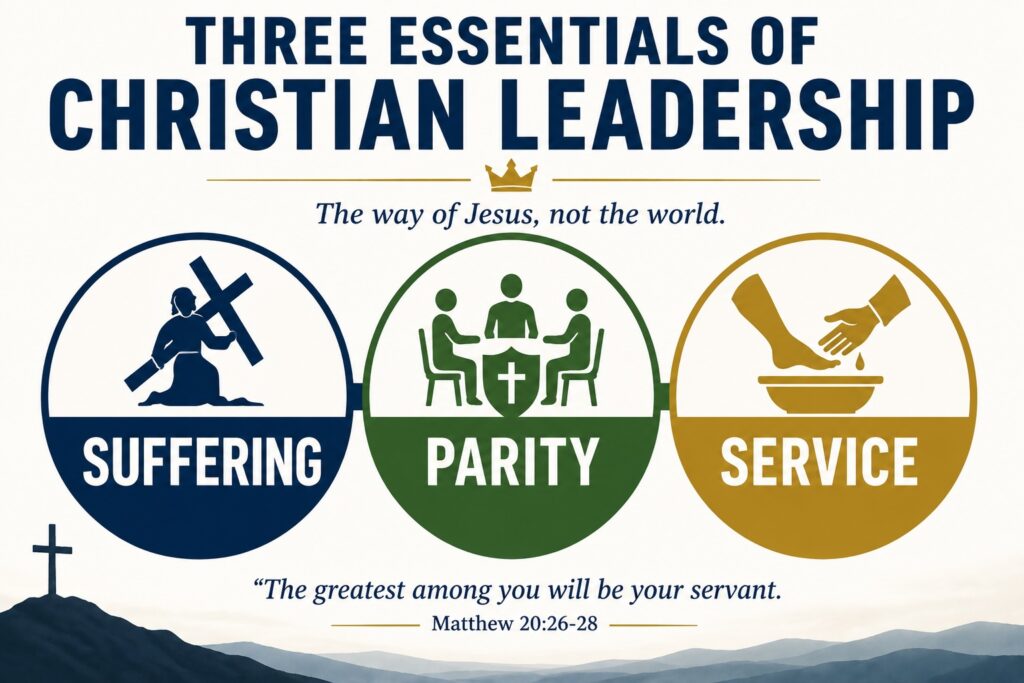
The three pillars of Christian leadership—Matthew 20:20-28
First pillar: Disposition to suffer
Verses 20-23
| These disciples were unaware that the call to Christian leadership is a call to suffering. The suffering involved often takes the form of psychological pressure and stress that others neither bear nor understand.
God in his sovereignty arranges things so the honors of the office are not equal to the pressures the leader endures. This eliminates motives other than the call of God. Be aware of your own motivations and those of people you are training. |
Second pillar: Parity
Verses 24-26
| This means all ministers are equal in authority and status in reformed church government. No hierarchies. |
The two disciples in the text thought the kingdom of God was a hierarchy like terrestrial kingdoms and wanted to ensure a good ranking for themselves.
Third pillar: Service
Verses 27 and 28
| Exhortation: Christian leadership focuses more on helping others than commanding them. It is a life given to service. V.28 |
 The right kind of confidence in service:
| Great self-confidence characterizes leaders in the world. Confidence in God characterizes the leaders of God’s people. The two disciples, James and John, showed the wrong kind of confidence when they said that they were capable. Yet shortly after this, along with the other disciples, they abandoned Jesus and fled.
Explain there is no job in the kingdom of God we are completely fit for. We would not have to rely on the Lord otherwise. God may give us jobs bigger than our natural abilities so we learn to rely on Him. This is why self-confidence in Christian leadership is so absurd. A strong confidence in God may look like self-confidence to others, but God knows the difference. |
Dangers in hierarchical government
Chapter 4 of textbook
- Disregard of the spiritual authority in the ordained offices.
- Arrogance
- Politicking for status or power
- Hierarchies tend toward mediocrity and inefficiency.
| The most serious danger in hierarchical government is the disregard of the spiritual authority of biblical offices and the anointing that accompanies it. |
For a fuller treatment, see Dangers of Hierarchy in Christian Organizations.
Discussion: How can we mitigate the dangers of hierarchical government in Christian organizations?
- Periodic anonymous evaluations of the leaders by the subordinates. Rarely does a Christian leader have the courage or integrity to do this.
- Ask advice of your subordinates.
Discussion: Compare the following two people and discuss differences in their leadership. Timothy, Philippians 2:18-21; Diotrephes, 3 John 8,9
From this lesson we learn…
- Christian leadership is fundamentally simple.
- It recognizes the sole concept of Christian leadership, taught and modeled by Christ himself.
- Integrity is a central virtue in Christian leadership.
- The word of God is sufficient for preparing effective Christian leaders.
Homework: Read Chapters 1-6 in the textbook.
Continue the Christian leadership course
This lesson introduces the biblical foundation of the course. The complete Teacher’s Guide continues with practical training in vision, planning, ethics, communication, dealing with difficult people, decision-making, and mentoring future Christian leaders.
Download the complete Christian Leadership Teacher’s Guide in PDF.
Course resources:
Christian Leadership (Textbook for this course)
About the author
Roger Smalling, D.Min., has served in Christian ministry and theological education for more than forty years, including missionary and leadership roles in Europe and Latin America. He developed leadership-training programs for pastors and church leaders and is the author of Christian Leadership and numerous theological and pastoral resources.