What does the Bible teach about baptism and the Lord’s Supper? This study guide presents the Reformed view of the sacraments, examining
their biblical foundation, covenant setting, meaning, and proper use.
Roger Smalling
About this study guide
Sacraments of the Reformed Faith is a teacher’s guide designed for small groups, Bible studies, and short seminars. From a Presbyterian and Reformed perspective, it examines the biblical principles underlying baptism and the Lord’s Supper and shows how the sacraments relate to the covenant of grace.
What the complete guide covers
The five lessons develop the subject progressively:
- Rules of interpretation — Biblical principles needed for studying the sacraments.
- The covenant of grace — The covenant framework for understanding the sacraments.
- Baptism—Its meaning, covenant significance, and mode.
- The Lord’s Supper — Major historical views, the presence of Christ, communion, and grace.
- Secondary issues — Questions such as paedo-communion, private communion, and communion for those unable to attend public worship.
Teacher instructions, discussion questions, exercises, and answers make the guide suitable for classroom or small-group instruction.
Sample lesson: Rules of interpretation
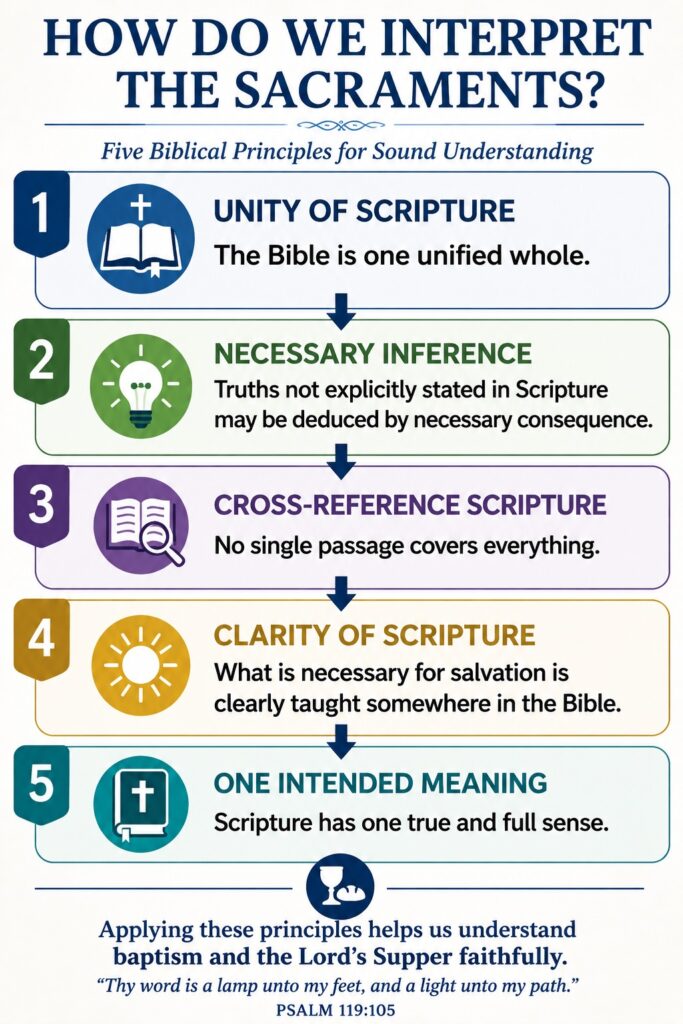
The following first lesson introduces the biblical principles of interpretation used throughout the study guide. The complete teacher’s manual continues with the covenant of grace, baptism, the Lord’s Supper, and several secondary sacramental questions.
Note: The texts in red are meant for the teacher only and are removed in the Student’s Study Guide.
Lesson One: Rules of interpretation in the study of sacraments
Explain why the study of sacraments is problematic. The Bible contains no apostolic dissertation on sacraments and therefore comes within the domain of inferential logic. We infer correct doctrine from a variety of clues within other subjects.
Certain rules of interpretation become especially important in the study of the sacraments. The reason is the biblical data is often a part of a discourse on other subjects.
Use elements of the first chapter of the Westminster Confession to establish the following principles of interpretation.
- Unity of scripture
- Validity of inferential logic
- Cross-referencing is necessary
- The principle of clarity.
- The singularity of interpretation.
Westminster Confession of Faith
Extracts from Chapter 1- Of the Holy Scriptures
Rules of Interpretation (Hermeneutics)
The unity of scripture
Contrary to dispensationalism, reformed theology views the Bible as a unit. Though we are not under the law, we are heirs of a covenant established in the Old Testament and fulfilled in the New.
The apostolic practices of sacraments are therefore fulfillments of Old Testament rites. A full understanding of the sacraments is impossible without a review of their Old Testament precedents.
Validity of inferential logic
“The whole counsel of God concerning all things necessary for His own glory, man’s salvation, faith and life, is either expressly set down in Scripture, or by good and necessary consequence may be deduced from Scripture:” Chapter 1, Article 6
Explain the difference between direct observation and inferential logic.
Example: Seeing a man walking down the beach is a direct observation and counts as eye witness evidence. Seeing the footprints in the sand of a man is an indirect observation from which we infer that a man was walking on the beach.
In most domains of study, including science and jurisprudence, most evidence is inferential. It is considered just as valid as a direct observation.
Both forms of evidence are valid for establishing facts.
So it is in theology. All the evidence for the Trinity is inferential. Most of the evidence for the deity of Christ is also inferential. Theologians consider these doctrines more than adequately established by the inferential evidence.
In the study of sacraments, all of the evidence is inferential. Examples of the practice of a sacrament are therefore unnecessary to establish sound doctrine, if the truth is founded on “good and necessary” deductions.
Example: We do not need an example of women taking communion. We only need to ask if the whole congregation participates and if women are members. This establishes the fact, with no need of examples.
The necessity of cross-referencing
“All things in Scripture are not alike plain in themselves, nor alike clear unto all: yet those things which are necessary to be known, believed, and observed for salvation are so clearly propounded, and opened in some place of Scripture or other, that not only the learned, but the unlearned, in a due use of the ordinary means, may attain unto a sufficient understanding of them.” Chapter 1, Article 7: Westminster Confession, 1648
No epistle exists to explain the details of baptism or the Lord’s Supper. All of the evidence is found within the context of other subjects. Therefore we need to accumulate these bits of data throughout the whole Bible to get a clearer picture.
The clarity of scripture
“The infallible rule of interpretation of Scripture is the Scripture itself: and therefore, when there is a question about the true and full sense of any Scripture (which is not manifold, but one), it must be searched and known by other places that speak more clearly. Chapter 1, Article 10 Westminster Confession, 1648
Even taking into account the need for inferential logic, the Bible is sufficiently clear that the average person can find out the truth on this subject, using the common sense principles of interpretation. In theology, this is called the perspicuity of scripture. [i]
The singularity of interpretation
“…full sense of any Scripture (which is not manifold, but one)“ WCF Chapter 1 Article 11
Our confessional standards assert that there exists only one correct interpretation of any scripture passage. If two Christians disagree about the meaning of a text, at least one is wrong, possibly both. It is inappropriate to and ask each person in a group what the verse means to them. It doesn’t matter what it means to them. It matters only what the writer intended, period. That meaning can be deduced by applying the above rules of hermeneutics. This view is supported by such texts as 2 Cor.1:12-13 and 2Pet.2:10.
Questions
- When a theology question is not “clearly propounded” in the Bible, what recourse do we have for knowing what is the correct doctrine? ________________________________________ [ii]
- What should we do when a biblical text does not seem to deal fully with a doctrinal question? ______________________________ [iii]
- The infallible rule for interpreting the Bible is ______________ [iv]
- What is the view of the Westminster Confession with regard to various interpretations of a text? __________________________ [v]
Continue with the complete study guide
The complete Sacraments of the Reformed Faith teacher’s manual continues with the covenant of grace, baptism, the Lord’s Supper, and important secondary questions concerning the sacraments.
Download the complete teacher’s manual in PDF.
Related resources
For further study, see these related resources:
- Baptism—A biblical examination of the meaning and practice of Christian baptism.
- Grace—A study of the nature and operation of God’s grace in salvation.
- Justification by faith—A biblical explanation of justification and the gospel of grace.
About the author
Roger Smalling is a retired Presbyterian missionary and theologian who served for many years in theological education in Latin America. His teaching materials emphasize Reformed theology and practical preparation for Christian ministry.
Notes:
[i] The reformers, especially Luther, elaborated this doctrine because the Catholic Church forbade laymen to possess the scriptures on the grounds that the word of God was too obscure for them to interpret. All interpretations, they said, must therefore be through the priest alone.
[ii] Find other texts in scripture that are clearer.
[iii] Take into account the totality of biblical teaching as it may relate to the subject at hand.
[iv] The Bible itself.
[v] There is only one correct interpretation of any verse. It can be deduced from the ordinary rules of interpretation.