Should churches sing only Psalms? While advocates of psalmody view exclusive Psalm singing as a biblical requirement, the New Testament emphasizes freedom, joy, and Christ-centered worship over restrictive regulations.
Roger Smalling, D.Min
************
Psalmody refers to a view held by some Reformed teachers that only Psalms should be sung in a public worship service. This is more than a personal preference to them. They present elaborate arguments designed to show that any other form of singing is unscriptural. Some who hold this view also exclude the use of musical instruments.
A friend wrote and asked my view of the issue, expecting an analysis of psalmody. My reply surprised him.
************
Dear Karl,
I haven’t given the psalmody question the depth of study you may feel it deserves. This choice is deliberate because I am convinced it deserves little study at all. The New Testament reflects an attitude that makes detailed analysis of psalmody unnecessary.
We turn away from rules and focus on Christ. From this perspective is born a new tone of freedom and joy throughout the New Testament.
Some might argue that the word “tone” is too vague and may sanction chaos. Liberty is difficult to define because it is intangible. That’s why I feel uncomfortable when someone asks for specific proof texts on the subject of worship.
Should churches sing only Psalms? The tone of the New Testament
We cannot ignore the tone of the New Testament, however imprecise that term may be. That is why I reject, for now, the psalmody teaching. It plays a different tune than the spontaneity and joy the New Testament sounds.
Yes, liberty is risky. Yet such risk is precisely what God wants us to take.
French horn illustration
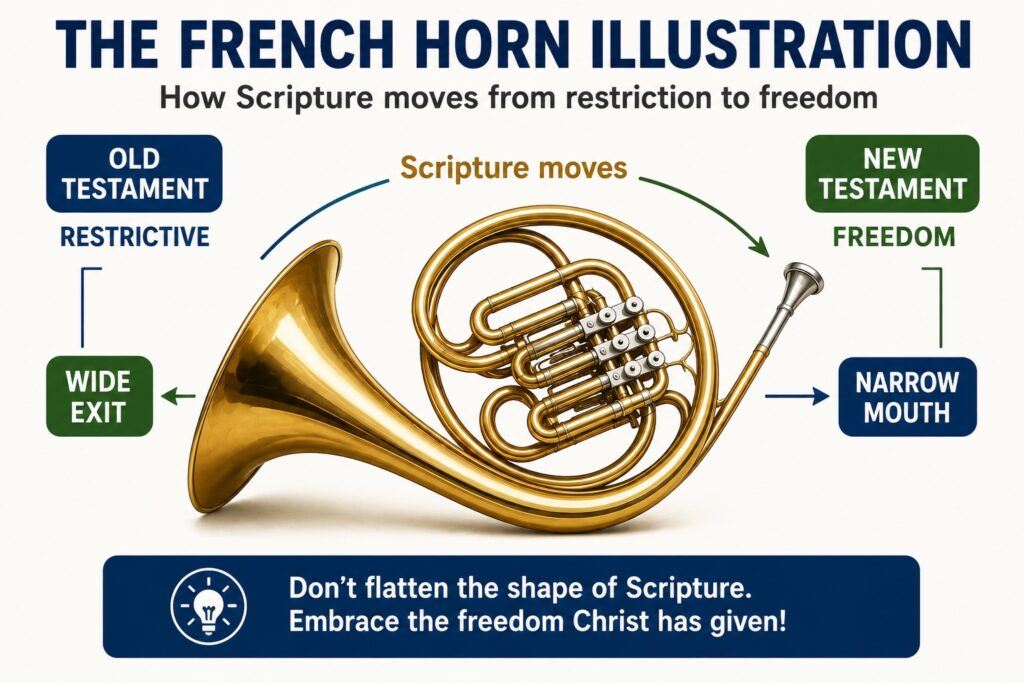 The structure of the Bible is like a French Horn, which starts out narrow at the mouth but wide at the exit. The Old Testament is restrictive, similar to the mouth of a horn. The New Testament declares a freedom of expression in our service to God within general guidelines.
Psalmodists treat the relationship between the Testaments like a person who detests the shape of a French horn. They take a hammer and laboriously straighten it out so the exit is as narrow as the mouth. Then they present it with a satisfied smile, pleased at their labor and insight into the correct shape of French Horns.
Perhaps the tone of their horn sounds better to them. To me, it sounds hollow.
Artistic freedom in worship
Luther’s “A Mighty Fortress”
 Artistic freedom takes a hit when confronted with psalmody. The most glaring example I have seen is what a psalmodist did to Luther’s majestic “A Mighty Fortress.” He replaced the lyrics with a Psalm, but not the Psalm as it appears in Scripture. He had to rearrange the words to make it fit the rhythm and rhyme of the hymn.
He replaced Luther’s superb poetry with a reworked Psalm. Result? Superb poetry replaced by poor poetry. What a tragedy!
I intend no sacrilege when I acknowledge some Psalms to be artistically inferior to some poetry outside of the Bible. The purpose and value of a psalm are primarily in its divine inspiration and the truth it conveys. Artistic merits are secondary. In my opinion, Luther’s hymn surpasses many of the Psalms in artistic quality, including the Psalm that was used to replace his words. The inspired quality of the psalm hardly justifies replacing extraordinary art with mediocre art. After all, Luther’s hymn expresses majestically the meaning of the Psalms.
Hebrew poetry and Western music
Hebrew poetry was based on thought-rhythm rather than meter and rhyme. They were sung to music that would seem strange to our Western ears today. We could never adapt to the Hebrew usage of the Psalms as they really practiced them. Even the most ardent psalmodist acknowledges this point. It amused me to see that the man who rearranged Luther’s hymn tried to make the words of the psalm rhyme! Even he could not escape his culture.
There are moments in my life when I would rather be a poet than a theologian. One of those moments is when I am worshiping.
Old Testament versus New Testament worship
Some Reformed teachers tend to interpret New Testament living in the light of the Old Testament. This approach seems backwards. Whenever I begin to feel constricted in ways the New Testament does not oblige, an alarm sounds in the back of my mind. Legalism could be lurking. When legalism enters, the Holy Spirit leaves. He prefers to dwell among free people.
Legalism and worship restrictions
The schoolmaster illustration
The law is a schoolmaster to lead us to Christ. Before coming to Christ, God treated His people like children. He had to because they acted spoiled most of the time. In Christ, He treats us like responsible adults. This relationship requires us to let go of the schoolmaster’s hand. Though we are perpetually God’ children, we must not confuse childlike with childish.
There is something bizarre about an adult walking down the street holding the hand of a schoolmaster.
A psalmodist once asked me if I had heard a thorough exposition of the psalmody position. I replied, “No, I have not. Nor am I inclined to bother, because when you are through, I will write Galatians 5:1 over all your arguments.”
It is for freedom that Christ has set us free. Stand firm, then, and do not let yourselves be burdened again by a yoke of slavery.
In Christ,
Roger
###
You may use this article for ministry purposes.
Suggested readings:
Music in Worship: Tradition or Contemporary?
If you liked this article, you may enjoy our book,
Joyfully Justified.