Not every threat to the church comes from outside. Wolves in the church often arise
from within the flock itself.
Acts 20:28-31
This article is an excerpt from the book,
 One key function of the New Testament elder is to watch for wolves in the church, those who may destroy the flock. Such individuals who may come in to provoke divisions and/or steal sheep are termed wolves in the church. Paul had to fight wolves constantly, and so do we. He had his legalists. Today we have false Christians and cults. Protecting the flock is a primary elder function.
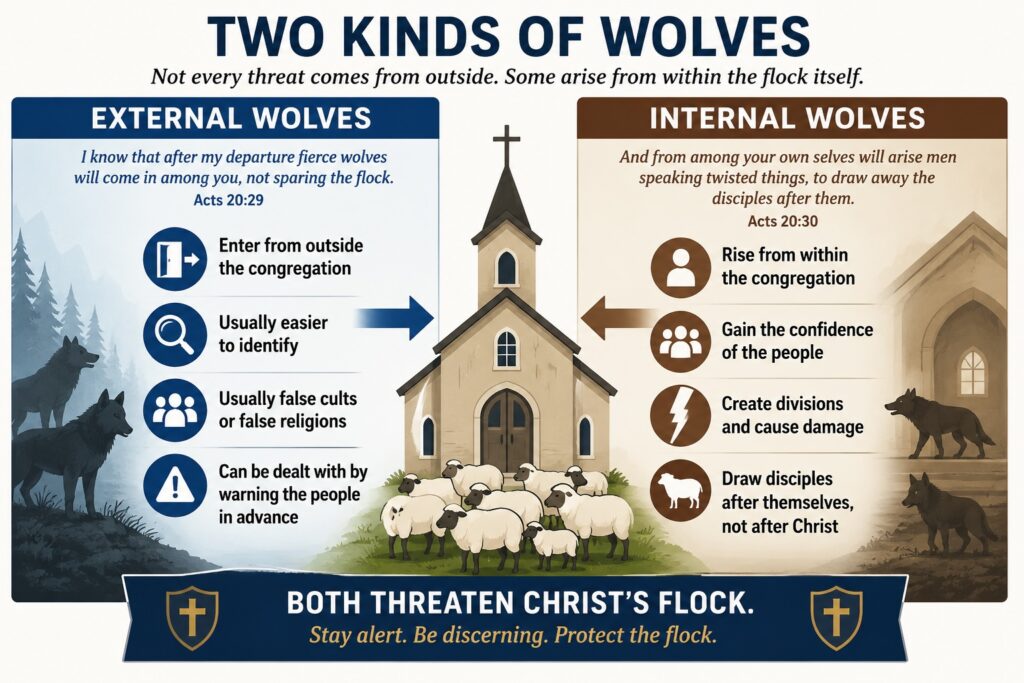
Two kinds of wolves
External wolves
I know that after my departure fierce wolves will come in among you, not sparing the flock. Acts 20:29 (ESV)
Paul spoke about wolves as being a certainty. Notice they usually wait until the leader is absent to enter. They realize the leader is likely to have the discernment to spot them. The phrase “enter in” shows that they are from outside the congregation. These are usually false cults and can be dealt with by warning the people in advance about what those cults are: Jehovah’s Witnesses, Mormons, etc. These wolves are usually recognizable by name and are therefore not as dangerous as the other kind. Simple instruction to the congregation about which groups to watch out for is usually sufficient.
Internal wolves
And from among your own selves will arise men speaking twisted things, to draw away the disciples after them. Acts 20:30
These are the most dangerous kind, because they are already in the church and therefore the most difficult to deal with.
They have pride and ambition in their hearts. (1) They are dissatisfied for some reason, and the devil begins to use them to draw away a following after them, rather than after Christ.
Both external and internal wolves are usually self-deceived and therefore do not see themselves as wolves. 2 Tim 3:13
Why God allows wolves
For there must be factions among you in order that those who are genuine among you may be recognized. 1 Cor 11:19
At no time will you learn more about the people under your charge than when wolves come in. Their loyalty, stability, and maturity will be put to the test. People you thought you could build on may be a disappointment. Others that you thought were weak will be stronger than you thought.
How to recognize wolves
- They always operate behind the backs of the leaders. Jn 10:1-2
- They will often visit individuals in their homes without the knowledge of the church leaders.
- They will try to obtain authority or position in the church without going through the leaders. Jesus taught that they come disguised as sheep. Mt 7:15-17
- A simple key to detect them is when they begin to steal sheep: sheep don’t steal sheep. Wolves do.
- They are critical of the leaders, often behind their backs. 2 Jn 9-10
- Everyone has weaknesses in his ministry. This does not grant people the right to criticize. At times, a wolf may make accurate criticisms. Such behavior does not justify undermining the ministry of a person, especially to weaker members of the church. Note what wolves said about Paul in 2 Corinthians 10:10.
- They boast of their spirituality. 2 Corinthians 10:12. However, Paul sarcastically mocks the spiritual pride of these wolves. They are often comparing themselves with others, and the comparisons always seem to turn out in their favor. They often claim to have more insight than the leaders and imply they have more to teach than the leader. 2 Thess 3:6
- They tend to provoke division. They invariably seek out weaker believers. Wolves seem to have an internal radar by which they detect weak believers. It may be a satanic form of discernment. They will invariably go straight for the weak believer and try to impress them. Ro. 16:18
How to deal with wolves
As for a person who stirs up division, after warning him once and then twice, have nothing more to do with him, Titus 3:10
Rebuking and rejecting
With nearly any other kind of problem you normally demonstrate patience, compassion, and mercy, but not so with wolves. You must show no patience, compassion, or mercy.
Paul’s instructions are clear: a wolf does not deserve more than two rebukes before throwing them out. Be very firm with them. Example: A person from a sect comes into your church. He sits quietly and makes no disturbance, but after the meeting, he sidles over to some weak believers. You discover he is getting addresses. You take him aside and warn him. He returns another time and does the same. Again, you warn him and stress that one more offense will mean closing the door to him. Again, he ignores you.
You then tell him to leave and not come back. A warning from the pulpit to the people may be necessary.
Running interference
The whole church, especially the mature believers, should be trained in how to run interference when there are wolves in the church.
This means simply stopping the wolf before he or she can reach out to the weaker ones after the meeting. They may engage them in conversation so that they will not have the opportunity to do damage. All mature believers in the church should understand that they may need to carry out such interception if necessary.
Note
(1) James 3:14-16
###
For further study:
Christian Leadership Training — Teacher’s Guide
Related Articles:
Is Formal Church Membership Biblical?
Is Catholicism Truly Christian?